Gee, this piece of news really made me dissillusioned. You've probably heard of the theory that all people in the world are connected in at most six steps. This urban myth sprung out of an experiment made by a guy called Stanley Milgram. He performed an experiment to see if he could get letter to a specific person far away from himself by only using a chain of friends. The result? On average it took six people to get to the final destination.
So what the problem? The problem is that in 97% of all the letters sent didn't reach its target at all! So drawing any conclusions on the 3% that's left is just totally bogus.
You can read a more detailed article over at BBC in the article Connecting with people in six steps.
2006-09-14


2006-09-13
Good film news
The other day tripped over some really pleasant film news. First and foremost: The Hobbit is going to happen! But it still remains to be seen whether it will be Peter Jackson who makes the movie. If he's going to make it it's not going to be anytime soon as he's signing up for quite a lot of projects right now. I would love for Peter Jackson to do The Hobbit though. Considering how Lord of the Rings turned out I don't think there is a single Tolkien fan who doesn't agree with me.
So they're going to make a Terminator 4. Which makes me skeptic. With no Linda Hamilton and no Arnold Schwarzenegger they really have to reinvent the whole concept to make a good movie out of it. I just wonder: Why? The first two Terminator movies are true classics. They don't need to undo film history as the Wachowski brothers did with the Matrix trilogy.
If I may digress a bit I'd like to take the moment to say a few words about Terminator 3 which I saw a few months ago. It wasn't as good as the first two but it wasn't that bad either. The movie didn't quite have that creepy feeling of the first two, the feeling of constantly being hunted by an unstoppable terminator. And the dystopic vision of the future wasn't quite there either. Also the choice of actors wasn't a very good one, especially the actor playing John Connor wasn't a very good choice. What really saved the movie was the ending.
The Thomas Crown Affair is getting a sequel which I think is exciting news. I like the movie a lot and the final heist in the movie is quite enjoyable.
Finally, not mentioned on the webpage I linked to above, it seems they're making a National Treasure 2. This is good news to me. National Treasure is one of those movies that I can watch over and over again and still enjoy it. I guess a lot of American history teachers are using it as it contains many highlights from American history. And I suppose there are enough interesting historical people and events in the US to make a second film. I'm looking forward to it.
So they're going to make a Terminator 4. Which makes me skeptic. With no Linda Hamilton and no Arnold Schwarzenegger they really have to reinvent the whole concept to make a good movie out of it. I just wonder: Why? The first two Terminator movies are true classics. They don't need to undo film history as the Wachowski brothers did with the Matrix trilogy.
If I may digress a bit I'd like to take the moment to say a few words about Terminator 3 which I saw a few months ago. It wasn't as good as the first two but it wasn't that bad either. The movie didn't quite have that creepy feeling of the first two, the feeling of constantly being hunted by an unstoppable terminator. And the dystopic vision of the future wasn't quite there either. Also the choice of actors wasn't a very good one, especially the actor playing John Connor wasn't a very good choice. What really saved the movie was the ending.
The Thomas Crown Affair is getting a sequel which I think is exciting news. I like the movie a lot and the final heist in the movie is quite enjoyable.
Finally, not mentioned on the webpage I linked to above, it seems they're making a National Treasure 2. This is good news to me. National Treasure is one of those movies that I can watch over and over again and still enjoy it. I guess a lot of American history teachers are using it as it contains many highlights from American history. And I suppose there are enough interesting historical people and events in the US to make a second film. I'm looking forward to it.
et al.
Do you know what the acronym "et al." stands for? It's the kind of expression you see every day and roughly know what it means but never quite know what it comes from and what it stands for. At least, that's the case for me. So, today I decided to look it up. And Answers.com gave the following definition:
So, it's Latin. No surprise there. And it's short for et alii. Which really baffles me. Why on earth don't we write out the whole et alii? Replacing the last to i:s with a dot only saves one character. It seems totally silly to me. In fact I'm thinking of using the full form, et alii, from now on. It's simply not that difficult to write out the whole thing.
A last thought. Why do we use Latin at all? "and others" is not that difficult to write. "and so on" is in many situations preferable to "et cetera" or "etc." I guess it is an old relic from the time when English children had to study Greek and Latin. Spicing your language with a bit of Latin was perhaps a way to show off and as time passed some phrases became standard. Personally I don't mind these Latin abbreviations but I can't help feeling that the language would be simpler without them.
et al.
Latin
et alii (and others)
So, it's Latin. No surprise there. And it's short for et alii. Which really baffles me. Why on earth don't we write out the whole et alii? Replacing the last to i:s with a dot only saves one character. It seems totally silly to me. In fact I'm thinking of using the full form, et alii, from now on. It's simply not that difficult to write out the whole thing.
A last thought. Why do we use Latin at all? "and others" is not that difficult to write. "and so on" is in many situations preferable to "et cetera" or "etc." I guess it is an old relic from the time when English children had to study Greek and Latin. Spicing your language with a bit of Latin was perhaps a way to show off and as time passed some phrases became standard. Personally I don't mind these Latin abbreviations but I can't help feeling that the language would be simpler without them.
Modern life leads to more depression among children
I've blogged before about the mental illness of children and teenagers. Yesterday 110 teachers, psychologists, children's authors and other experts sent an open letter to the brittish paper Telegraph with the title Modern life leads to more depression among children. The letter is short and doesn't get into any details. The main purpose is to start a public debate about these questions.
Together with the public letter the Telegraph also had a short article around these issues "Junk culture 'is poisoning our children'".
This letter cause a bit of a stir in the blogosphere. Slashdot had some surprisingly good comments about this. And via Planet Haskell (yes, believe it or not) I stubled upon an interesting post about parenting.
I'll refrain from commenting about all this as I'm not a parent myself. But make sure to read the articles I've linked to. It's both interesting and thought provocative.
Together with the public letter the Telegraph also had a short article around these issues "Junk culture 'is poisoning our children'".
This letter cause a bit of a stir in the blogosphere. Slashdot had some surprisingly good comments about this. And via Planet Haskell (yes, believe it or not) I stubled upon an interesting post about parenting.
I'll refrain from commenting about all this as I'm not a parent myself. But make sure to read the articles I've linked to. It's both interesting and thought provocative.
2006-09-08
Lunar Eclipse

So, we've just had a very small partial eclipse. Did you see it? Well, I managed to capture it with my camera so you can see how it looked on the picture to the right. Not too exciting, but still.
Lunar eclipses are nice in the way that they can be seen from many more places than a solar eclipse. Basically half of the world can watch it at the same time. But I guess that solar eclipses are cooler because they're so hard to catch.
If you want to know more about lunar eclipses Wikipedia is helpful as always.
2006-09-05
Programming Quotations
It's quote time again! This time a whole heap of Programming Quotations. There's lots of classics in there but most of them I haven't heard before. And some of them aren't specific to programming.
Some of my favourites:
Some of my favourites:
It has been said that the great scientific disciplines are examples of giants standing on the shoulders of other giants. It has also been said that the software industry is an example of midgets standing on the toes of other midgets. -- Alan Cooper
Some problems are so complex that you have to be highly intelligent and well informed just to be undecided about them. -- Laurence J. Peter
A notation is important for what it leaves out. -- Joseph Stoy
I've finally learned what "upward compatible" means. It means we get to keep all our old mistakes. -- Dennie van Tassel
2006-09-01
The Scientific Refereeing Process
Via shapr's blog I came across an article by what seems to be a very bitter mathematician yelling about the way scientific journals and conferences work.
In my experience the situation is not as bad as he describes it but there is a point to what he is saying nevertheless.
One reaction againts crappy researchers who organize conferences with no refereeing might be to fire them. The problem is, the universities that hire them might not be too keen on firing them. Why? Well, every university need to have its quota of scientists, right? It would look really bad for a university to not have any scientists. And since the number of research positions in universities is a log bigger than there are good researchers then universtities will fill their positions with lesser researchers.
Sigh. What to do about this whole mess? Well, I find comfort in that there is a lot of good research going on too. And I just try to do my part in increasing our knowledge, which is what science is all about.
In my experience the situation is not as bad as he describes it but there is a point to what he is saying nevertheless.
One reaction againts crappy researchers who organize conferences with no refereeing might be to fire them. The problem is, the universities that hire them might not be too keen on firing them. Why? Well, every university need to have its quota of scientists, right? It would look really bad for a university to not have any scientists. And since the number of research positions in universities is a log bigger than there are good researchers then universtities will fill their positions with lesser researchers.
Sigh. What to do about this whole mess? Well, I find comfort in that there is a lot of good research going on too. And I just try to do my part in increasing our knowledge, which is what science is all about.
Why People Don't Use Mass Transit
I bought a car a year and a half ago. For quite some time I didn't use it to drive to work but lately I've abandoned the tram in favour for the car. But I keep thinking about switching back.
Since I'm thinking quite a bit about these questions I was delighted to find a page explaining Why People Don't Use Mass Transit. The author of this piece takes a purely economical view of the problem. And his main point is that if you put a price tag on time then it's really hard to beat using the car. How do one put a price tag on time? Well, what do you earn for 40 hours of work? Divide that amount by 40 hours and you have a price per hour. Using the salary to measure the cost of the time taken to travel may not be exactly what people use when deciding whether to take the car or not. But it is clear that people do value time since they take the car to such a large extent, and using the salary is in my opinion a pretty good instrument here.
So, have I decided to use the car since I read the article? No. I'm leaning towards switching back to the tram. But I keep postponing the switch. The car's just to convenient.
Since I'm thinking quite a bit about these questions I was delighted to find a page explaining Why People Don't Use Mass Transit. The author of this piece takes a purely economical view of the problem. And his main point is that if you put a price tag on time then it's really hard to beat using the car. How do one put a price tag on time? Well, what do you earn for 40 hours of work? Divide that amount by 40 hours and you have a price per hour. Using the salary to measure the cost of the time taken to travel may not be exactly what people use when deciding whether to take the car or not. But it is clear that people do value time since they take the car to such a large extent, and using the salary is in my opinion a pretty good instrument here.
So, have I decided to use the car since I read the article? No. I'm leaning towards switching back to the tram. But I keep postponing the switch. The car's just to convenient.
2006-08-30
Electric Mini
OK, here's a bit of bit of prejudice for you. I believe most guys have a particular car which they long for to have. I know I do anyway, despite my rather low interest in things-with-motors. And it's the Mini (note the cool url).
I just read an article about a modified Mini, called the
Treehugger: Electric Mini. The novel thing with this car is that it has the engines in its weels and is driven mostly by electricity. Though strictly speaking it's a hybrid car. The advantages with this approach are interesting: it's both more environment friendly and it gives the car more power. Though I bet it costs alot more.
Before the Electric Mini there were only four custom made Mini's that were electric. Those for were made for the 2003 remake of the movie The Italian Job. The thing was, they wanted to drive the cars around in the subway, but weren't allowed to bring any combustion vehicle down there. So they called BMW and had four cars custom made with electric engines only.
I just read an article about a modified Mini, called the
Treehugger: Electric Mini. The novel thing with this car is that it has the engines in its weels and is driven mostly by electricity. Though strictly speaking it's a hybrid car. The advantages with this approach are interesting: it's both more environment friendly and it gives the car more power. Though I bet it costs alot more.
Before the Electric Mini there were only four custom made Mini's that were electric. Those for were made for the 2003 remake of the movie The Italian Job. The thing was, they wanted to drive the cars around in the subway, but weren't allowed to bring any combustion vehicle down there. So they called BMW and had four cars custom made with electric engines only.
2006-08-24
The Gettysburg Powerpoint Presentation
I just happened to trip upon what is "one of the sharpest pieces of satire to appear on the web". It is The Gettysburg Powerpoint Presentation by Peter Norvig(head of Google research). The reason he made it was to show just how bad PowerPoint presentation get the message across. His initial intent was to spend a lot of time finding bad colors and fonts but he found that the Autocontent Wizard did all that work for him. Hilarious.
2006-08-16
Trivia
Today I discovered a rather unexpected piece of trivia about two actors. I was watching the end of the movie Addams Family Values and I noticed to my delight that Peter MacNicol was in the movie. He seems to be a very funny guy, all the characters I've seen him portray have been very special.
When the movie was over and the end titles flashed by I thought I recognized one name. The name was David Krumholtz. And no wonder I recognized him. He's the leading actor in Numb3rs playing the young mathematics professor who helps FBI solve crimes. But when he did Adams Family Values he was only 15 years old. So I don't blame myself for not recognizing him in the movie.
And now for the fun part. Both Peter MacNicol and David Krumholtz had roles in the Adams Family Values. As it turns out they would reunite 12 years later in Numb3rs. Peter MacNicol plays the somewhat eccentric physicist who is the best fried of the mathematics professor portrayed by Krumholtz.
You don't think it's funny? I know it's kind of random. But it's just that I like Numb3rs and discovering that MacNicol and Krumholtz was in the same movie way back was a bit like being struck by lightning. Or something like that.
When the movie was over and the end titles flashed by I thought I recognized one name. The name was David Krumholtz. And no wonder I recognized him. He's the leading actor in Numb3rs playing the young mathematics professor who helps FBI solve crimes. But when he did Adams Family Values he was only 15 years old. So I don't blame myself for not recognizing him in the movie.
And now for the fun part. Both Peter MacNicol and David Krumholtz had roles in the Adams Family Values. As it turns out they would reunite 12 years later in Numb3rs. Peter MacNicol plays the somewhat eccentric physicist who is the best fried of the mathematics professor portrayed by Krumholtz.
You don't think it's funny? I know it's kind of random. But it's just that I like Numb3rs and discovering that MacNicol and Krumholtz was in the same movie way back was a bit like being struck by lightning. Or something like that.
2006-08-07
IntroComp 2006
I spent a couple of hours last week playing text adventure games. Text based games are a relic from the 70's and 80's but they still enjoy a small and devoted community. And people are writing a lot of new games still.
The games I played were all submissions to the contest IntroComp 2006. This contest has a rather interesting setup. Each participant is invited to submit a game which isn't finished. Only the introduction in the game needs to be done. The submissions are rated based on how much the voters want to see the whole game finished. There are some real money involved when winning but there is a caveat. You only get the money after you've finished your game. And the higher your ranking, the more money you get when you finish your game. It's a pretty nice setup to increase the incentive for writers to actually finish their games. Of course, games which are just slapped together to get the money will not receive any.
So I had some fun playing the games in this competition and I participated as a voter. This was the very first time I participated in any way in such a contest and I'm quite likely to do it again. One of the most amusing things with this contest was the announcement of the results. This happen in the IfMUD. A MUD, in case you don't know, is like an online text adventure game. The interface is completely text based and you can walk around in the world and meet other people a solve puzzles. The IfMUD works more like a chat than an ordinary MUD though. The announcements of the IntroComp contest was made in a particular room inside the MUD. I really liked the experience, there was a lot of funny people there and the general atmosphere was very inviting. I'll probably spend some time in the IfMUD in days to come.
Lastly, here are some reviews of the games in the competition.
The games I played were all submissions to the contest IntroComp 2006. This contest has a rather interesting setup. Each participant is invited to submit a game which isn't finished. Only the introduction in the game needs to be done. The submissions are rated based on how much the voters want to see the whole game finished. There are some real money involved when winning but there is a caveat. You only get the money after you've finished your game. And the higher your ranking, the more money you get when you finish your game. It's a pretty nice setup to increase the incentive for writers to actually finish their games. Of course, games which are just slapped together to get the money will not receive any.
So I had some fun playing the games in this competition and I participated as a voter. This was the very first time I participated in any way in such a contest and I'm quite likely to do it again. One of the most amusing things with this contest was the announcement of the results. This happen in the IfMUD. A MUD, in case you don't know, is like an online text adventure game. The interface is completely text based and you can walk around in the world and meet other people a solve puzzles. The IfMUD works more like a chat than an ordinary MUD though. The announcements of the IntroComp contest was made in a particular room inside the MUD. I really liked the experience, there was a lot of funny people there and the general atmosphere was very inviting. I'll probably spend some time in the IfMUD in days to come.
Lastly, here are some reviews of the games in the competition.
2006-08-05
Three Sins of Authors in Computer Science and Math
I stumbled upon some nice piece of advice for writing articles today. It's called Three Sins of Authors in Computer Science and Math. And I know I'm guilty on all three accounts. But I just got a paper accepted which needs to be finished pretty soon so I'll have a good opportunity to use the advice right away.
2006-08-01
Brought up to mental illness
One thing that's been on my mind a lot lately is the mental health of youngsters in our country. A recent article in our local newspaper reports that 1/4 of all 16-year-olds have hurt themselves in one way or another. This is a really scary figure. A lot of young people are feeling bad today and even has to go to such lengths as hurting themselves to get some relief from their mental suffering.
I've always assumed that the fundamental reason for this is that parents doesn't care enough about their children. Sweden has a very self centered culture and that can make children be less important that the parent itself. So my suggestion to solve the problem has been to spend more time with and care for the children.
But today I read a very interesting article in Psychology Today called "A Nation of Wimps". This article suggest rather the opposite of my assumption. The problem is that parents micromanage their children, keep them away from anything that might hurt them or make them sad and they do just about anything to make sure that their children get high grades so that they can attend prestigious colleges.
It this way children have no chance to develop the right cognitive tools to make it through life.
True, the article from Psychology Today concerns the US. But it might be relevant to Sweden as well. The International Herald Tribune has a very nice article about Swedes as 'safety junkies' and 'curling parents', a swedish expression for overprotecting parents. It might be that swedish parents are just as bad when it come to overprotecting their children.
It seems that we have somehow forgotten what good parenting is. And commercial interests have invaded the whole parenting area and profits from anxious parents.
The political party Kristdemokraterna (roughly Christian Democrats) is the party which profile itself towards families. Their suggestions for the upcoming election is to put the parents in charge of their children's upbringing and kindergarten and give parents more time with their children. I've always thought that this sounds like a really good idea and a good way towards making young adults feel better. But the above articles suggest that this line, while not bad, won't help this particular problem.
So what can we do about it? I don't know. Parenting courses? But who's to give them? But clearly we need a solution soon. There's a lot of young people who are not feeling well right now.
I've always assumed that the fundamental reason for this is that parents doesn't care enough about their children. Sweden has a very self centered culture and that can make children be less important that the parent itself. So my suggestion to solve the problem has been to spend more time with and care for the children.
But today I read a very interesting article in Psychology Today called "A Nation of Wimps". This article suggest rather the opposite of my assumption. The problem is that parents micromanage their children, keep them away from anything that might hurt them or make them sad and they do just about anything to make sure that their children get high grades so that they can attend prestigious colleges.
It this way children have no chance to develop the right cognitive tools to make it through life.
True, the article from Psychology Today concerns the US. But it might be relevant to Sweden as well. The International Herald Tribune has a very nice article about Swedes as 'safety junkies' and 'curling parents', a swedish expression for overprotecting parents. It might be that swedish parents are just as bad when it come to overprotecting their children.
It seems that we have somehow forgotten what good parenting is. And commercial interests have invaded the whole parenting area and profits from anxious parents.
The political party Kristdemokraterna (roughly Christian Democrats) is the party which profile itself towards families. Their suggestions for the upcoming election is to put the parents in charge of their children's upbringing and kindergarten and give parents more time with their children. I've always thought that this sounds like a really good idea and a good way towards making young adults feel better. But the above articles suggest that this line, while not bad, won't help this particular problem.
So what can we do about it? I don't know. Parenting courses? But who's to give them? But clearly we need a solution soon. There's a lot of young people who are not feeling well right now.
The Weakest Link in Security
A while ago I attended a workshop drawing together most of Sweden's PhD students working in one way or the other with security. As you might expect the program was pretty diverse ranging from very hard core technical stuff to very fluffy stuff bordering on politics and human computer interaction.
There was one talk that I'd like to comment on. It was titled "Are Humans The Weakest Link In Security?" or something like that. The speakers intention with the title was to be a bit provocative. Many of my fellow PhD students which lean more to the technical side smiled at this title: "Of course humans are the weakest link!" They seemed to think that the question was rather silly.
I have a different opinion. My answer to the question is rather "Humans SHOULD be the weakest link". Otherwise technology has failed. Technology is here to help us. Sure, some of us like technology just for the fun of it. But the adoption of technology can only be motivated if it helps us in some way. This is especially true when it comes to security. If technology is a weaker link than its users what good is it then.
I don't think the question posed by the speaker was silly. I think it is good to ask such questions and ponder upon the answer. It might not be as straightforward as you might think.
There was one talk that I'd like to comment on. It was titled "Are Humans The Weakest Link In Security?" or something like that. The speakers intention with the title was to be a bit provocative. Many of my fellow PhD students which lean more to the technical side smiled at this title: "Of course humans are the weakest link!" They seemed to think that the question was rather silly.
I have a different opinion. My answer to the question is rather "Humans SHOULD be the weakest link". Otherwise technology has failed. Technology is here to help us. Sure, some of us like technology just for the fun of it. But the adoption of technology can only be motivated if it helps us in some way. This is especially true when it comes to security. If technology is a weaker link than its users what good is it then.
I don't think the question posed by the speaker was silly. I think it is good to ask such questions and ponder upon the answer. It might not be as straightforward as you might think.
Learning Haskell
John Meacham has his own way of explaining how it is to learn Haskell:
From the Haskell-Cafe mailling list.
It is best to think of haskell primitives as something completely new, they reuse some naming conventions from OO programming, but that doesn't mean they suffer from the same limitations. It took me a few trys to wrap my brain around it. I liken learning haskell to tipping over a vending machine. you can't just push it, you gotta rock it back and forth a few times building up momentum until bam! suddenly the flash of insight hits and it all makes sense.
From the Haskell-Cafe mailling list.
2006-07-31
Scientists Say Erie Mirage Could Be Real
I've had a very nice and relaxing holiday for the past couple of weeks. That's why there's been so little blogging. But since I started work today I thought I should do some blogging. So I'll start with a link to a story found via Reddit about an mysterious whether fenomenon acting as a lens. abc News has the story:
Scientists Say Erie Mirage Could Be Real
Scientists Say Erie Mirage Could Be Real
2006-07-10
Dynamism
I hang out at Lambda The Ultimate, a site for discussing programming language design and implementation. Contrary to most such discussions this site usually has very well informed arguments and is almost free of flame wars.
One of the best posters at Lambda The Ultimate is Frank Atanassow. He is very knowledgeable, very brainy, is very good on theory and above all, very funny. I'd say he wins the humor contest hands down. And today I read a post by him which cements his position as the no. 1 humorist on Lambda The Ultimate. You can find the original post here, although I quote it in its entirety below. Enjoy:
One of the best posters at Lambda The Ultimate is Frank Atanassow. He is very knowledgeable, very brainy, is very good on theory and above all, very funny. I'd say he wins the humor contest hands down. And today I read a post by him which cements his position as the no. 1 humorist on Lambda The Ultimate. You can find the original post here, although I quote it in its entirety below. Enjoy:
"Dynamic" is technical jargon used by programmers, meaning "good". It derives from the Latin dyno mite, meaning "I am extremely pleased", and is first recorded in the historical work Bona Aetas of noted Roman sage and pundit J.J. Walker. Its meaning evolved in the 4th century after monks copying an obscure manuscript on programming linguistics in their ignorance tried to deduce its meaning from context.
In this (occidental) manuscript, the Lingua Lambda, the author described how he had stumbled across Miranda, an early ancestor of Haskell, a typed language that had found its way to the West from the Orient, and which, though crude in some ways, supported many fine features and was, in fact, lauded as the language for discriminating hackers. The author wrote an essay about this language, describing its features, and noted (Miranda dyno mite!) how pleased he was with it.
These monks had lived in monasteries for most of their lives, programming only in C; most of them had never heard of languages like ML or Miranda, and, if they had, would have dismissed them as Oriental nonsense. But this century was, for these monks, also a time of change; the last barbarian invasion had been repelled, but the fleeing barbarians had left behind their legacy, the untyped programming languages. Many of these were adopted by such monks — and thus we now call them "scripting languages" — who were dazzled by features such as "blocks" and "duck typing". (One can still detect in these phrases the vulgarity of their barbarian progenitors. Naturally, the West promptly plunged into a dark age...)
In the Orient, though, typed languages had long supported features such as higher-order functions, structural typing, automatic garbage collection, REPL-style interactive interpretation and user-definable syntax. But for the monks laboring in darkness, these were thoroughly new ideas, and they reasoned that they must be uniquely characteristic of untyped languages.
So it was that they translated Miranda dyno mite as Miranda is untyped, and now we must live with that confusion. Given the meaning of the words in our everyday language, it is, when you pause to think about it, strange that when a programmer asks you how you are, the proper response is "Dynamic, thanks!" if you are feeling well and "Kinda static today..." if you are ill, but the history of language is full of twists and turns, and, after all, far from rational...
2006-07-05
The Shallow Roots of the Human Family Tree
Yahoo News has a very interesting article called Roots of human family tree are shallow. It's essence is this: Not too long ago, say 2000 to 5000 years, there lived a person which is an ancestor to all now living people. And a little longer while back, between 5000 and 7000 years ago, every person living then either an ancestor to all people living today or their line died out.
It's pretty amazing and sounds ridiculous until you read the article. The math needed to get an intuition for this is dead simple. I won't spoil the fun here, I recommend instead that you read the article. It's a lot of fun!
It's pretty amazing and sounds ridiculous until you read the article. The math needed to get an intuition for this is dead simple. I won't spoil the fun here, I recommend instead that you read the article. It's a lot of fun!
2006-07-03
Time out of mind
In today's very science oriented society we learn that time is something very exact. To illustrate time we draw a straight line and place the time units on equal distance between each others. Each second arrive at a constant rate and disappears just as quickly.
Yet our subjective notion of time is quite different. When we sleep we have little notion of time, for instance. Just as when we're having a lot of fun. Then time seems to go very fast. On the other hand when we are in a car accident time seems to slow down. We seem to be able to perceive things and react much more quickly.
One interesting question is how the physical and our mental notion of time relates. The other day I read about a truly clever experiment which tries to test whether our brain actually works faster when we are in a stressful situation. The setup goes like this: a man is set to do a backwards free-fall of 33 meters. With him he will have a small wristwatch-like device which will switch blindingly fast between two different images. One of the pictures will be a number. Under normal circumstances a person cannot make out the number since the device flickers so fast. But if time actually slowed down for him he might be able to see the number on the screen. It's a pretty clever setup.
How did it go? When the test person landed he said he had seen the number "98". The actual number shown was "96". Close enough for me. Further experiments yielded similar results. So it seems that our brains actually works faster in some situations! Very intriguing.
You can read about the experiment in the bbc article Time out of mind. It has some further goodies on time as well.
Yet our subjective notion of time is quite different. When we sleep we have little notion of time, for instance. Just as when we're having a lot of fun. Then time seems to go very fast. On the other hand when we are in a car accident time seems to slow down. We seem to be able to perceive things and react much more quickly.
One interesting question is how the physical and our mental notion of time relates. The other day I read about a truly clever experiment which tries to test whether our brain actually works faster when we are in a stressful situation. The setup goes like this: a man is set to do a backwards free-fall of 33 meters. With him he will have a small wristwatch-like device which will switch blindingly fast between two different images. One of the pictures will be a number. Under normal circumstances a person cannot make out the number since the device flickers so fast. But if time actually slowed down for him he might be able to see the number on the screen. It's a pretty clever setup.
How did it go? When the test person landed he said he had seen the number "98". The actual number shown was "96". Close enough for me. Further experiments yielded similar results. So it seems that our brains actually works faster in some situations! Very intriguing.
You can read about the experiment in the bbc article Time out of mind. It has some further goodies on time as well.
2006-07-02
More Mammatus
More mammatus clouds! This time it's a link to WEATHER WARS, via reddit. Make sure to scroll down a bit to get to the nice pictures. The clouds shown there look very odd, they don't have the usual bubble shape. More like waves, like an upside down ocean. Anyway, totally sweet.
2006-06-25
String Theory: Not Even Wrong.
Via /. I found the following intriguing article:Northwest Florida Daily News: Has string theory tied up better ideas in physics? It argues that String Theory really hampers the advancement of our knowledge in particle physics. The theory (which isn't really a theory at all) has failed to produce any kind of predictions, be them testable or not. The author further argues that it is just the latest fad, scientists has to pursue it or say goodbye to an academic career. But if many of these new scientists would have tried to make advancements through other means than String Theory, perhaps we would have gotten further?
I, for one, was rather surprised by this article, as I've read a lot of positive things about String Theory. But I think that the author has a valid point. And I hope that this and similar articles will result in a diversification of the field of particle physics. Perhaps we can finally make some progress after 30 years of stand still in the field.
I, for one, was rather surprised by this article, as I've read a lot of positive things about String Theory. But I think that the author has a valid point. And I hope that this and similar articles will result in a diversification of the field of particle physics. Perhaps we can finally make some progress after 30 years of stand still in the field.
2006-06-20
Characterizing people as non-linear, first-order components in software development
I just read a very interesting paper on software methodology. What makes a software project succeed? That's the basic question the author tries to answer.
I tend to think in terms of tools when I think about software success. Program in a better language and you're much better off! Use a better IDE! Automate test generation using QuickCheck! All these suggestions are good. But according to the author of this paper called "
Characterizing people as non-linear, first-order components in software development" tools are a second order effect. The single most important thing for software projects is the people in the projects. The programmers. It feels obvious when I write it like this. But think of all the methodologies developed to improve programmer productivity. What we should be focusing on are the people. Who they are, how they behave, what habits they have. We need to embrace that people are different, prone to errors, reluctant to change their habits and tend to communicate best face to face.
Reading this paper was a liberating experience. Having a human centric view is just right. We need to have this perspective even in other parts of society. A swedish politician once said that those political systems that fail are those that are based upon a false or too narrow view of what people are. Such as communism for instance. We need to understand ourselves and accept each other as we are. Only then can we be truly happy and truly productive.
Btw, I found the article via Shae Erisson's blog.
I tend to think in terms of tools when I think about software success. Program in a better language and you're much better off! Use a better IDE! Automate test generation using QuickCheck! All these suggestions are good. But according to the author of this paper called "
Characterizing people as non-linear, first-order components in software development" tools are a second order effect. The single most important thing for software projects is the people in the projects. The programmers. It feels obvious when I write it like this. But think of all the methodologies developed to improve programmer productivity. What we should be focusing on are the people. Who they are, how they behave, what habits they have. We need to embrace that people are different, prone to errors, reluctant to change their habits and tend to communicate best face to face.
Reading this paper was a liberating experience. Having a human centric view is just right. We need to have this perspective even in other parts of society. A swedish politician once said that those political systems that fail are those that are based upon a false or too narrow view of what people are. Such as communism for instance. We need to understand ourselves and accept each other as we are. Only then can we be truly happy and truly productive.
Btw, I found the article via Shae Erisson's blog.
2006-05-20
Adventure
An adventure is only an inconvenience rightly considered. An inconvenience is an adventure wrongly considered.
- G. K. Chesterton
The Death of the Save Icon
I noticed something strange the other day. In my text editor the icon for saving the document looks like floppy disc. A floppy disc?! I can't remember the last time I used a floppy disc. That's so last millennium. Do people still use them? As far as I know computers don't even ship with floppy drives anymore. Just out of curiosity I had to check some other programs to see what icon the use for saving. All the programs I checked, including MSOffice, OpenOffice, Adobe Reader (although their icon looks more like a zip disc), Google Skethup and GIMP, had a floppy disc as their save icon. The only exception I found was jEdit which used a pencil.
Since we don't use floppy discs anymore we need to come up with a better icon for saving. The floppy disc used to be a good symbol but in a few years it will just be confusing as people will have forgotten what it is. The question is then what icon to use. I certainly don't know. And perhaps it's not even the right question to ask. Maybe we shouldn't be saving things anymore at all. At least not manually. What if the text editor automatically synchronized the copy of the text document in memory with that on the disc? This is already happening to some extent with automatic saves but I think it could (and should) be taken much further.
But is it possible to completely eliminate manual saving? Probably no. I often download PDF documents which end up in the browser cache when I view them for the first time. But sometimes I want to save a copy of the document in some specific place on my hard drive. Then I really want to save manually. Or perhaps copying is a better word for it. Anyhow it will need an icon and the floppy disc icon is outdated. So, all graphics designers out there, I'm waiting for a better save icon!
Since we don't use floppy discs anymore we need to come up with a better icon for saving. The floppy disc used to be a good symbol but in a few years it will just be confusing as people will have forgotten what it is. The question is then what icon to use. I certainly don't know. And perhaps it's not even the right question to ask. Maybe we shouldn't be saving things anymore at all. At least not manually. What if the text editor automatically synchronized the copy of the text document in memory with that on the disc? This is already happening to some extent with automatic saves but I think it could (and should) be taken much further.
But is it possible to completely eliminate manual saving? Probably no. I often download PDF documents which end up in the browser cache when I view them for the first time. But sometimes I want to save a copy of the document in some specific place on my hard drive. Then I really want to save manually. Or perhaps copying is a better word for it. Anyhow it will need an icon and the floppy disc icon is outdated. So, all graphics designers out there, I'm waiting for a better save icon!
2006-05-15
The only acronym I know of which takes longer time to pronounce than the words it stands for
Try for your self: WWW vs. World Wide Web.
2006-05-11
Cars in the next lane really do go faster
Since I bought myself a car about a year and a half ago I've spent an increasing amount of time in traffic jams. Sitting in a traffic jam is the perfect place for pondering the mysteries of the world. Such as why the other lane seems to move faster on average than the lane I'm in. This might seem like a logical fallacy but it is not. The time a driver spend in the slower lane is longer than that of a driver in the faster lane. This is simply because the slower lane is, well, slower.
So, this is roughly how my thoughts have been going every time I've been in a traffic jam. And I was very much delighted today when I read an article called Cars in the next lane really do go faster which confirms my theory albeit with a slightly different explanation. It turns out that this result belongs to the field of observation selection effects and which has all kinds of interesting applications. I'll be sure to learn more about this in the future.
So, this is roughly how my thoughts have been going every time I've been in a traffic jam. And I was very much delighted today when I read an article called Cars in the next lane really do go faster which confirms my theory albeit with a slightly different explanation. It turns out that this result belongs to the field of observation selection effects and which has all kinds of interesting applications. I'll be sure to learn more about this in the future.
2006-05-04
Playing with Google Sketchup
About a week ago Google released the program Sketchup for free. Or rather, they release a trimmed down version of Sketchup where you can only save stuff to Google Earth. The idea is quite nice, letting people modeling stuff for their own amusement in Google Earth and thus making Google Earth richer.
Of course I had to try this. So I downloaded Sketchup and went through the tutorial. I must say that I'm really impressed with the tutorial. After having finished it I felt like: Wow, this is SO simple! I can do marvelous 3D modeling without tears! So I had to try my own little project. I decided to create a model of the house I'm living in. Which turned out to be not quite as easy as the tutorial had been. At times it became really frustrating. One problem, or rather mixed blessing, is that Sketchup is trying hard to guess what it is that you want to do. For example it helps you making lines perpendicular or aligning various point. While this can be good I found it to be a real frustration and I didn't find any way to turn it off. But in the end I managed to come up with something that at least remotely resembles the place I live. This is how it looks when imported into Google Earth.
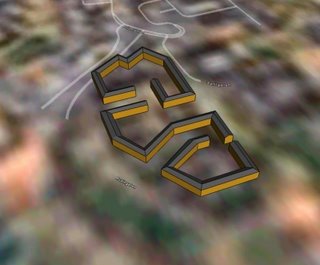
Note the incredibly bad resolution Google Earth has of Göteborg. Shame on you Google! You ought to buy the same maps as eniro has.
I've create a .kmz file for you to download and see Rubingatan for your self in Google Earth.
Of course I had to try this. So I downloaded Sketchup and went through the tutorial. I must say that I'm really impressed with the tutorial. After having finished it I felt like: Wow, this is SO simple! I can do marvelous 3D modeling without tears! So I had to try my own little project. I decided to create a model of the house I'm living in. Which turned out to be not quite as easy as the tutorial had been. At times it became really frustrating. One problem, or rather mixed blessing, is that Sketchup is trying hard to guess what it is that you want to do. For example it helps you making lines perpendicular or aligning various point. While this can be good I found it to be a real frustration and I didn't find any way to turn it off. But in the end I managed to come up with something that at least remotely resembles the place I live. This is how it looks when imported into Google Earth.
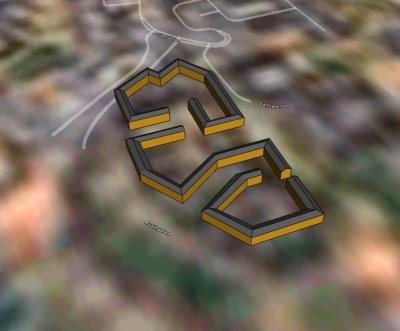
Note the incredibly bad resolution Google Earth has of Göteborg. Shame on you Google! You ought to buy the same maps as eniro has.
I've create a .kmz file for you to download and see Rubingatan for your self in Google Earth.
2006-04-26
Switching back from Foxit to Adobe
For about a week I've been using Foxit Reader to read my PDF files. I open a handful of PDF files a day and I've been very happy with the snappiness of Foxit. It's just so much quicker that Adobe Reader to startup and consumes much less memory and CPU while running. All in all, I was very happy with it.
Until today. In the middle of reading a document I started to feel motion sick. Or something like that. I felt it difficult to read the text and it felt like the text was bouncing around on the screen. And once I became aware of this feeling it wasn't difficult to find the source of the problem. The letters was almost literally dancing on the screen. This is what it looked like:
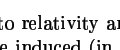
Notice how the baseline of the letters goes up and down? The letters 'l', 'i' and 'v' is placed higher than the other letters. This is what made me feel motion sick.
First I thought that there was something wrong with the document. To verify this I opened it in Adobe Reader with the following result:
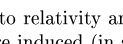
No more motion sickness.
So the Foxit story was just too good to be true. Although fast, it is a crappy renderer. As I spend a lot of time reading PDFs with lots of text this simply isn't an alternative for me. I've now switched back to Adobe Reader. And deleted Foxit Reader.
Until today. In the middle of reading a document I started to feel motion sick. Or something like that. I felt it difficult to read the text and it felt like the text was bouncing around on the screen. And once I became aware of this feeling it wasn't difficult to find the source of the problem. The letters was almost literally dancing on the screen. This is what it looked like:

Notice how the baseline of the letters goes up and down? The letters 'l', 'i' and 'v' is placed higher than the other letters. This is what made me feel motion sick.
First I thought that there was something wrong with the document. To verify this I opened it in Adobe Reader with the following result:

No more motion sickness.
So the Foxit story was just too good to be true. Although fast, it is a crappy renderer. As I spend a lot of time reading PDFs with lots of text this simply isn't an alternative for me. I've now switched back to Adobe Reader. And deleted Foxit Reader.
2006-04-25
2006-04-21
Rainbow pictures
Just spotted this on digg. Some simply amazing
pictures of rainbows. I just had to blog it! And don't miss the last picture on the page. It doesn't have a rainbow but is still sunningly beautiful.
pictures of rainbows. I just had to blog it! And don't miss the last picture on the page. It doesn't have a rainbow but is still sunningly beautiful.
2006-04-18
Laterna Magica
It was several years since I had a reading experience like this. Only a handful of times before have I been captured by a book like this. The book is 'Laterna Magica'; the autobiography of Ingemar Bergman.
I haven't read much of late. Due to my hard work and the sick leave that followed I haven't read a single book in a year. I simply haven't had the strength. When I have picked up a book it has felt like a long and heavy project and I've simply had to put it away. Which has been very frustrating since I used to read quite a lot. During my years as an undergraduate at Chalmers I typically read an hour or so every day. I've come to understand that that's very uncommon.
Laterna Magica is an ancient kind of projector in english known as the magic lantern. It mostly resembles a slide projector but used painted on pieces of glass instead of slides. Ingemar Bergman got a Laterna Magica on his tenth birthday.
Friday last week, Good Friday, my fiance and I went to her parents to spend the weekend. As it turned out we were shown to a new room to sleep in, not the usual one that we normally use. The new room used to belong to my fiance's little sister. On one of her shelves I found a copy of Laterna Magica and curiously started leafing through it. It didn't take long before I realized that I had actually started reading the book. And I just couldn't stop.
This isn't the kind of book I plan to read. First of all it's a biography which is usually enough to scare me away. But secondly, and more important is that it feels extremely pretentious to read an autobiography of one of the greatest filmmakers ever to have lived. It's like reading the book of nobel prize winners. It's like I should read it just so that I can brag about having read it despite what I may think about it. I just don't plan to read books like this. But I'm happy now that I did read it.
I haven't read much of late. Due to my hard work and the sick leave that followed I haven't read a single book in a year. I simply haven't had the strength. When I have picked up a book it has felt like a long and heavy project and I've simply had to put it away. Which has been very frustrating since I used to read quite a lot. During my years as an undergraduate at Chalmers I typically read an hour or so every day. I've come to understand that that's very uncommon.
Laterna Magica is an ancient kind of projector in english known as the magic lantern. It mostly resembles a slide projector but used painted on pieces of glass instead of slides. Ingemar Bergman got a Laterna Magica on his tenth birthday.
Friday last week, Good Friday, my fiance and I went to her parents to spend the weekend. As it turned out we were shown to a new room to sleep in, not the usual one that we normally use. The new room used to belong to my fiance's little sister. On one of her shelves I found a copy of Laterna Magica and curiously started leafing through it. It didn't take long before I realized that I had actually started reading the book. And I just couldn't stop.
This isn't the kind of book I plan to read. First of all it's a biography which is usually enough to scare me away. But secondly, and more important is that it feels extremely pretentious to read an autobiography of one of the greatest filmmakers ever to have lived. It's like reading the book of nobel prize winners. It's like I should read it just so that I can brag about having read it despite what I may think about it. I just don't plan to read books like this. But I'm happy now that I did read it.
2006-04-10
Mammatus Clouds
Digg had a very nice link today to mammatus clouds. These clouds simly look amazing! As I've mentioned before I'm just nuts about clouds. When I saw the pictures of the mammatus clouds I took out my copy of the nice "The Book of Clouds" by Dr. John "Cloud Man" Day. Unfortunately the book didn't have very much to say about mammatus and neither has wikipedia. But the mammatus article at University of Illinois is OK. Gee, I wish I get a chance to see this kind of clouds for real some time.
Geek wear
There's some really nice apparels over at cafepress. I'm thinking specifically about geek wear. Like the classic about understanding binary. There is a similar one about time. Since I'm a Haskell programmer there is ofcourse the Haskell shop. I've bought the mouse pad with that Haskell logo. Today, on #haskell, some guy linked to some new cool Haskell related clothes. The first link is simply a nice logo. The other was sime very cute toddler wear, both for boys and girls. But my personal faviourite is a variant on the "What part of ... don't you understand?". Go check it out for yourself.
2006-04-04
On Semantic Nuances
Today I had a rather interesting discussion with some of my colleagues. Andreas Abel is visiting Chalmers this week. Since he was working here for some time he is quite good at swedish and so we spoke swedish with him. But he wasn't quite sure of the swedish word for 'scientist' and tried 'vetenskapare' which makes kind of sense consider the general way that one can construct words in swedish but the actual term is 'vetenskapsman'. Which made us realize that the term 'vetenskapsman' isn't used about scientists today in swedish. Although 'vetenskapsman' corresponds to 'scientist' in english it has a different connotation. Instead the word 'forskare' is used which corresponds to 'researcher'.
So what do swedes really mean when they say 'vetenskapsman'? Ulf Norell suggested that it meant a scientist from say 16th or 19th century i.e. way back in history. Similarly, I suggested a scientist which has contributed to what is considered established scientific truths. But we couldn't really decide how precise these definitions were. Michael Hedberg then joined the discussion and said that the word 'vetenskapsman' made him think of Frankenstein or mad scientists in general. I'm not sure that does the job either but it is clear that the term has some very strange connotations which makes it unsuitable for today's scientists.
While it can be very interesting to try to think about what people mean with certain words I must also offer a word of caution. All too many argument are really about the definition of words. Never engage in such arguments. They are completely pointless and lead to nothing. Instead try to understand what people mean when they say something and when it seems strange to you ask them to be more precise. If their definition of a word doesn't correspond to yours then simply accept their definition as a hypothetical viewpoint and move on. There are more important things to argue about.
So what do swedes really mean when they say 'vetenskapsman'? Ulf Norell suggested that it meant a scientist from say 16th or 19th century i.e. way back in history. Similarly, I suggested a scientist which has contributed to what is considered established scientific truths. But we couldn't really decide how precise these definitions were. Michael Hedberg then joined the discussion and said that the word 'vetenskapsman' made him think of Frankenstein or mad scientists in general. I'm not sure that does the job either but it is clear that the term has some very strange connotations which makes it unsuitable for today's scientists.
While it can be very interesting to try to think about what people mean with certain words I must also offer a word of caution. All too many argument are really about the definition of words. Never engage in such arguments. They are completely pointless and lead to nothing. Instead try to understand what people mean when they say something and when it seems strange to you ask them to be more precise. If their definition of a word doesn't correspond to yours then simply accept their definition as a hypothetical viewpoint and move on. There are more important things to argue about.
How to pour Ketchup.
You just got to love it! Here's an article which delves into the mysteries of getting ketchup out of a bottle:How to pour Ketchup (Catsup). Full technical explanation. The thing is, the standard techniques, such as hitting the bottom of the bottle doesn't work very well.
The irony is that this article is mostly useless. People buy squeeze bottles nowadays.
The irony is that this article is mostly useless. People buy squeeze bottles nowadays.
2006-04-01
Applications of Randomness in System Performance Measurement
Here is a link to a PhD thesis entitled Applications of Randomness in System Performance Measurement. I haven't actually read the dissertation but the abstract is quite informative in itself. Here's a quote from the second paragraph:
When I read this several papers came to my mind which I suddenly realize doesn't hold water. Just as the above text says these papers report improvements which might just as well be noise.
The abstract then goes on to explain the contributions of the thesis:
Next time I'm about to measure the efficiency of a computer program I'm going to read this dissertation carefully. Today's computer system with all their complex ways to trying to speed up things has made measurements much more difficult. It seems that a little bit of randomness at the right place is the key which can alleviate these problems.
For TCP/IP, changes of a few percent in link propagation delays and other parameters caused order of magnitude shifts in bandwidth allocation between competing connections. For memory systems, changes in the essentially arbitrary order in which functions were arranged in memory caused changes in runtime of tens of percent for single benchmarks, and of a few percent when averaged across a suite of benchmarks. In both applications the measured variability is larger than performance increases often reported for new improved designs, suggesting that many published measurements of the benefits of new schemes may be erroneous or at least irreproducible.
When I read this several papers came to my mind which I suddenly realize doesn't hold water. Just as the above text says these papers report improvements which might just as well be noise.
The abstract then goes on to explain the contributions of the thesis:
To make TCP/IP and memory systems measurable enough to make benchmark results meaningful and convincing, randomness must be added. [...] We show how to choose reasonable amounts of randomness based on measuring configuration sensitivity, and propose specific recipies for randomizing TCP/IP and memory systems. Substantial reductions in the configuration sensitivity are demonstrated, making measurements much more robust and meaningful. The accuracy of the results increases with the number of runs and thus is limited only by the available computing resources.
Next time I'm about to measure the efficiency of a computer program I'm going to read this dissertation carefully. Today's computer system with all their complex ways to trying to speed up things has made measurements much more difficult. It seems that a little bit of randomness at the right place is the key which can alleviate these problems.
Hektor
I just have to write about this beautiful little thing called Hektor: which was featured on digg. It is a little machine consisting of two motors, a holder for a spray can, a bit of circuitry and wiring and when it is plugged into a computer sprays beautiful pictures. The design is so simple and elegant that the machine in itself is a piece of art. Make sure to watch the videos of Hector at work, they are fascinating to look at. I only wish I could have done this myself.
2006-03-31
The Seven Warning Signs of Bogus Science
I just read a great article on how to maintain healthy skepticism towards what is said to be incredible scientific breakthroughs called The Seven Warning Signs of Bogus Science. There's a lot of people out there who simply doesn't understand the way scientific research is done or simply wants to call themselves scientists so that they can get more credibility. The advises from this article can work nicely as a guide to when you should have a closer look at what you hear about or even dismiss it.
2006-03-28
Planet Haskell
Planet Haskell was launched a couple of days ago and now it is is hosted at planet.haskell.org. It aggregates a couple of Haskell related feeds into one blog. I think this is a very nice idea. It also makes me think that I should start blogging more about programming. This blog I use for all kinds of nonsense so maybe I should start my own programming related blog. When I'm thinking about it I do have quite a lot of things to write about that is programming related.
2006-03-27
Fancy Pants Adventure
Via digg.com I found this marvelous flash based platform game called Fancy Pants Adventure. Not only has it really cool graphics, hilarious animations and sweet music, it is also very playable with well designed levels. The game play borrows heavily from Sonic the Hedgehog. The general style of the game when it comes to graphics, sound and humor reminds me of Neverhood, another awesome game although not a platform game.
The only disappointment with this game is that it only features one world with three levels. I played through this pretty quickly including finding all the secrets ("collecting trophies" in FancyPants lingo). When finishing the last level it says that it will be continued. I sure hope that will be the case.
The only disappointment with this game is that it only features one world with three levels. I played through this pretty quickly including finding all the secrets ("collecting trophies" in FancyPants lingo). When finishing the last level it says that it will be continued. I sure hope that will be the case.
2006-03-25
The markings of a geek
OK. I admit it. I am a geek. A true geek.
This weekend me and my girlfriend visited her parents. While browsing their bookshelves my eyes were almost magnetically drawn to one title: Firefox. I felt an immediate urge to read the book despite the fact that I didn't know anything about it. The only reason I had was that I use the browser Firefox for my daily surfing. Now, how geeky is that on a scale between 1 and 10? Well, I don't know but I would rank it pretty high.
Since I'm in the mood for confessing my geekiness I might as well confess another little episode I've had. This one is about perfume, which in itself lowers my geek score but only marginally. Once I was reading the paper and my eyes fell on an ad for perfume for men. Now, these ads don't normally draw my attention but this one did big time because of a single fact: The name of the perfume was π. I was actually quite embarrassed by my immediate urge to buy this perfume, I wasn't wearing that much perfume at all at the time (and I still don't, although this perfume did boost my perfume usage quite a bit for a while). So I resisted the urge for at least two years. But whenever I saw the ad or the actual perfume in some store I felt I simply had to buy it. Eventually I couldn't resist it, returning home with a much too expensive perfume whose name was a transcendental number. I was a fragrant, happy geek.
This weekend me and my girlfriend visited her parents. While browsing their bookshelves my eyes were almost magnetically drawn to one title: Firefox. I felt an immediate urge to read the book despite the fact that I didn't know anything about it. The only reason I had was that I use the browser Firefox for my daily surfing. Now, how geeky is that on a scale between 1 and 10? Well, I don't know but I would rank it pretty high.
Since I'm in the mood for confessing my geekiness I might as well confess another little episode I've had. This one is about perfume, which in itself lowers my geek score but only marginally. Once I was reading the paper and my eyes fell on an ad for perfume for men. Now, these ads don't normally draw my attention but this one did big time because of a single fact: The name of the perfume was π. I was actually quite embarrassed by my immediate urge to buy this perfume, I wasn't wearing that much perfume at all at the time (and I still don't, although this perfume did boost my perfume usage quite a bit for a while). So I resisted the urge for at least two years. But whenever I saw the ad or the actual perfume in some store I felt I simply had to buy it. Eventually I couldn't resist it, returning home with a much too expensive perfume whose name was a transcendental number. I was a fragrant, happy geek.
2006-03-17
Piled Higher and Deeper
Since before my previous post I've had a very long blogging slump where I haven't written anything here. So once I got back to this blog I went through a couple of my old posts just to refresh my memory on what I had been writing about before. When I came to the Calvin & Hobbes post I realized it was not right. Apart from Calvin & Hobbes and Zits there is actually one other comic strip that read on a regular basis and enjoy. It is Piled Higher and Deeper. The strip is about a couple of PhD students at Stanford University. Of course the humor is very much concentrated around the life of a PhD student with low salary, long working ours, ignorance from the supervisor and the inability to graduate on time. I don't think it is very well known for people other than PhD students. But as far as I know it is pretty popular among PhD students, at least in the States. So if you're a PhD student I can warmly recommend it. A key element in humor is self recognition and I think you will find a lot of that in this strip.
Completely unrelated: this is my 100th post on this blog. Yay!
Completely unrelated: this is my 100th post on this blog. Yay!
2006-03-16
Curse of the Were-Rabbit
Yesssssss. Finally! It arrived today. My copy of Wallace & Gromit - Curse of the Were-Rabbit on DVD. I've been waiting for this for several weeks now, almost counting the days.
Now I'm going to watch this movie till the DVD player breaks down. I just love this movie. I gave it 10 on imdb.com. And I was very happy to see that it got the Oscar it so well deserved.
Now, if you'll excuse me, I'm going to lock myself in and spend the rest of my life watching this movie.
Now I'm going to watch this movie till the DVD player breaks down. I just love this movie. I gave it 10 on imdb.com. And I was very happy to see that it got the Oscar it so well deserved.
Now, if you'll excuse me, I'm going to lock myself in and spend the rest of my life watching this movie.
2006-02-04
Switching torrent client
I don't know about you but once I've found a way to do something I tend to stick with it. If it works OK why should I change it? It's probably because I'm lazy. Or that I don't want to be bothered. I have so much to think about anyway that my brain is totally overloaded. I don't want to spend time and brain power on learning something new when I have something that already works.
But recently I've tried to be a little more open to new solutions and to learn new ways of doing things. I think it started sometime during 2003. For some reason I told my supervisor that I was using Pine as my email program (it's a text based program, dating back from the 80's). I thought it pretty hard-core to use it. But my supervisor wasn't impressed at all. He told me that technology has improved, that better alternatives exists and that it can be very productive to switch. Which I did. And I haven't missed Pine since.
After that I've been trying to learn the lesson from my supervisor. I shouldn't be afraid of learning to do new things as they can help me a lot. Usually new tools help to boost productivity. One such switch I made about a year ago it from CVS and Subversion to darcs. Maintaining my code is now a joy compared to before.
So where am I heading with this rambling? I'm heading for the day before yesterday. I made another switch. A switch that I am particularly happy about. I switched torrent client.
I've been using Azureus for some time and I have been quite happy with it. It is a feature packed client that also sports plugins which means endless of functionality. Nice of course. But then I read about a torrent client at digg.com which a lot of people there seemed to like. It was called uTorrent. Since so many people seemed to like it I decided to check it out. From what I read it seemed to be a very small client with very modest resource consumption. So I downloaded and installed it. Once I had installed it and tried uTorrent it took me less that a minute to decide to uninstall Azureus. While Azureus has a lot of nice features it is also rather bloated and resource hungry. It takes the computer for quite an exercise. Not so with uTorrent. It's binary is only 130kB! Can you believe that?! It takes up very little memory and is blazingly fast. You won't notice that you're running it in the background. And despite having such a small footprint it is packed with features. It has everything I ever needed when downloading or seeding torrents. The switch to uTorrent was not only easy, it was liberating.
Discovering uTorrent also gave me some hope about current and future software. A lot of programs nowadays are rather bloated and resource hungry. Why is that? When I was programming in assembler on my c64 we could squeeze in a lot of functionality in just a couple of kB. Now, I don't claim that we should always program with resource efficiency in mind. Correctness and programmer productivity are more important. But I often find that making a program small makes it easier to make it correct and can often boost my productivity. There need not be a tension here. I think many programmers and companies have things to learn here. There's a blogpost at zdnet about this which uses uTorrent as an example.
Finally, the switch to uTorrent wasn't made any more difficult by the fact that Ludvig Strigeus, the author of uTorrent, is an old student of mine. :-)
But recently I've tried to be a little more open to new solutions and to learn new ways of doing things. I think it started sometime during 2003. For some reason I told my supervisor that I was using Pine as my email program (it's a text based program, dating back from the 80's). I thought it pretty hard-core to use it. But my supervisor wasn't impressed at all. He told me that technology has improved, that better alternatives exists and that it can be very productive to switch. Which I did. And I haven't missed Pine since.
After that I've been trying to learn the lesson from my supervisor. I shouldn't be afraid of learning to do new things as they can help me a lot. Usually new tools help to boost productivity. One such switch I made about a year ago it from CVS and Subversion to darcs. Maintaining my code is now a joy compared to before.
So where am I heading with this rambling? I'm heading for the day before yesterday. I made another switch. A switch that I am particularly happy about. I switched torrent client.
I've been using Azureus for some time and I have been quite happy with it. It is a feature packed client that also sports plugins which means endless of functionality. Nice of course. But then I read about a torrent client at digg.com which a lot of people there seemed to like. It was called uTorrent. Since so many people seemed to like it I decided to check it out. From what I read it seemed to be a very small client with very modest resource consumption. So I downloaded and installed it. Once I had installed it and tried uTorrent it took me less that a minute to decide to uninstall Azureus. While Azureus has a lot of nice features it is also rather bloated and resource hungry. It takes the computer for quite an exercise. Not so with uTorrent. It's binary is only 130kB! Can you believe that?! It takes up very little memory and is blazingly fast. You won't notice that you're running it in the background. And despite having such a small footprint it is packed with features. It has everything I ever needed when downloading or seeding torrents. The switch to uTorrent was not only easy, it was liberating.
Discovering uTorrent also gave me some hope about current and future software. A lot of programs nowadays are rather bloated and resource hungry. Why is that? When I was programming in assembler on my c64 we could squeeze in a lot of functionality in just a couple of kB. Now, I don't claim that we should always program with resource efficiency in mind. Correctness and programmer productivity are more important. But I often find that making a program small makes it easier to make it correct and can often boost my productivity. There need not be a tension here. I think many programmers and companies have things to learn here. There's a blogpost at zdnet about this which uses uTorrent as an example.
Finally, the switch to uTorrent wasn't made any more difficult by the fact that Ludvig Strigeus, the author of uTorrent, is an old student of mine. :-)
2006-02-02
MythBusters on Star Wars
There's a great article about the MythBusters over at Star Wars Community called Putting Star Wars to the MythBusters Test. It gives some nice background info about the MythBusters and their involvement in the Star Wars prequels. They also talk about various things in the Star Wars movies they would like to try on the show.
2006-01-31
"And the nominees are ..."
It's that time of the year again. Time to guess who's going to win an Oscar. Today the Academy announced the nominees for the 78th Annual Academy Award. Here is a list of the nominees from imdb.com.
Many of the nominated films I haven't seen but I'll comment on some of the nominations and non-nominations.
First of all I was very sad not to see Gwyneth Paltrow nominated for her role in Proof. I really liked her performance in that movie. But I guess the movie producers didn't hire enough lobbyists to get a nomination.
The movie which got the most technical nominations is King Kong. I guess the Academy is tired of handing out those Oscars to Star Wars movies. Revenge of the Sith only got one nomination. And that's for makeup! A bit of a disgrace for Mr. Lucas.
The one Oscar I'm really crossing my fingers for this year is Best Animated Feature Film of the Year. It just has to go to Wallace and Gromit! That film is absolutely spectacular! I've preordered it on DVD to make sure I get it quickly.
Apart from that I'm rather ignorant about the other nominations. Which really means it's going to be a pretty boring event for me. I suppose I could go and watch some of the nominated movies. But I really don't feel like seeing any of them. Oh, well. I'll guess I just have to wait till next year.
Many of the nominated films I haven't seen but I'll comment on some of the nominations and non-nominations.
First of all I was very sad not to see Gwyneth Paltrow nominated for her role in Proof. I really liked her performance in that movie. But I guess the movie producers didn't hire enough lobbyists to get a nomination.
The movie which got the most technical nominations is King Kong. I guess the Academy is tired of handing out those Oscars to Star Wars movies. Revenge of the Sith only got one nomination. And that's for makeup! A bit of a disgrace for Mr. Lucas.
The one Oscar I'm really crossing my fingers for this year is Best Animated Feature Film of the Year. It just has to go to Wallace and Gromit! That film is absolutely spectacular! I've preordered it on DVD to make sure I get it quickly.
Apart from that I'm rather ignorant about the other nominations. Which really means it's going to be a pretty boring event for me. I suppose I could go and watch some of the nominated movies. But I really don't feel like seeing any of them. Oh, well. I'll guess I just have to wait till next year.
2006-01-30
A load of Quotes
Since I simply can't resist a good quote or two I was just ecstatic to see the page Quotations for CS1. It has a ton of computer science related quotes. I would have picked some favorites told you about them but there are simply too many quotes in this page to digest in just a day or two. I'll make sure to come back to this page from time to time when I feel a quote urge.
2006-01-24
Install fonts easily on Windows XP
There is one task that I occasionally do with my Windows computer which I think is horribly complicated: installing a font. The official way to do it is so long and tedious that I refuse to spell it out here but if you're interested click this link. All that it needed to install a font is to just copy it to the right directory. I could of course copy the fonts manually but that is only a little more efficient than the official way and then I need to remember which directory the fonts should go into.
So, instead of just complaining about the problem here is a tweak for Windows XP which makes it painless to install fonts. When implemented, this tweak enables you to install a font simply by right-clicking on it and select 'install'. Couldn't be easer. Here's how it's done:
And you're done!
Now you can easily install your fonts from explorer by simply right-clicking on them and select 'Install'. If you want to try it out here are some web sites with free fonts that I can recommend:
So, instead of just complaining about the problem here is a tweak for Windows XP which makes it painless to install fonts. When implemented, this tweak enables you to install a font simply by right-clicking on it and select 'install'. Couldn't be easer. Here's how it's done:
- Open Explorer. Open the 'Tools' menu and choose 'Folder Options'.
- Click the tab 'File Types'.
- Locate the file type 'OpenType Fonts' in the list and select it. It has extension 'OTF'.
- Click 'Advanced'.
- Click 'New'.
- In the first field write 'Install'.
- In the second field write 'C:\WINDOWS\system32\xcopy.exe "%1" C:\WINDOWS\Fonts'
- Click 'OK' and then 'OK' again.
- Now, locate the file type 'TrueType Fonts' and select it. It has extension 'TTF'.
- Repeat steps 4 through 8.
- Click 'OK'.
And you're done!
Now you can easily install your fonts from explorer by simply right-clicking on them and select 'Install'. If you want to try it out here are some web sites with free fonts that I can recommend:
- FreeFonts is a huge resource of free fonts.
- TypeNow.net has some nice movie and music fonts.
- Divide by zero fonts has some really weird but cool fonts.
2006-01-23
Beautiful pictures
I'm a new and happy user of the photo site Flickr. Flickr lets you easily upload and share your photos over the internet. Organize then, label them, search others photos and so forth. It's a nice site.
Today I found a spectacular set of photos. The thing is, I very much like clouds. Mostly Cumulus. But clouds in general. And the photo set I found has the most amazing pictures of clouds above green fields. I could sit and watch these pictures hours on end. They're absolutely beautiful.
Today I found a spectacular set of photos. The thing is, I very much like clouds. Mostly Cumulus. But clouds in general. And the photo set I found has the most amazing pictures of clouds above green fields. I could sit and watch these pictures hours on end. They're absolutely beautiful.
2006-01-21
I'm a genius!
I'm a genius! I'm a genius! I'm a genius! I'm a genius! I'm a genius! I'm a genius! I'm a genius! I'm a genius! I'm a genius! I'm a genius! I'm a genius! I'm a genius! I'm a genius! I'm a genius! I'm a genius! I'm a genius! I'm a genius! I'm a genius! I'm a genius! I'm a genius! I'm a genius! I'm a genius! I'm a genius! I'm a genius!
I'm a genius!
Just so you know.
According to the MENSA Intelligence Test anyone who scores 19 or above on the test is a genius. Which is exactly what I have done. So, therefore I'm entitled to call myself genius.
I'd prefer if anyone who reads this post and talks to me or writes me an email henceforth call me "The Genius". Otherwise I might not respond.
I'm a genius!
Just so you know.
According to the MENSA Intelligence Test anyone who scores 19 or above on the test is a genius. Which is exactly what I have done. So, therefore I'm entitled to call myself genius.
I'd prefer if anyone who reads this post and talks to me or writes me an email henceforth call me "The Genius". Otherwise I might not respond.
Commodore 64 forever!
This is just too good to be true!
During the late 80's and early 90's I spent quite a lot of time on front of the computer. And not just any computer, the Commodore 64. By today's standards it's not even a pocket calculator and when I used it it had gotten pretty old already. But even though it lacked speed and features it was still possible to make great games on it. The games you found for the c64 was just awesome! Some of my favorites where Giana Sisters, Wizball and Wonderboy.
Now I can play these games in my browser! Some geniuses has created a Java applet which can run those old c64 games. Brilliant! They've made it available on the site c64s.com.
The game companies don't make these kind of games anymore. They probably feel that it would be an insult to the hardware they're programming on if they made simple games. Yet many people spend endless hour playing the simplest games such as Snood and the games that comes with Windows. Well, I suppose that's a segment of the market which the big companies have decided to hand over to the shareware crowd.
During the late 80's and early 90's I spent quite a lot of time on front of the computer. And not just any computer, the Commodore 64. By today's standards it's not even a pocket calculator and when I used it it had gotten pretty old already. But even though it lacked speed and features it was still possible to make great games on it. The games you found for the c64 was just awesome! Some of my favorites where Giana Sisters, Wizball and Wonderboy.
Now I can play these games in my browser! Some geniuses has created a Java applet which can run those old c64 games. Brilliant! They've made it available on the site c64s.com.
The game companies don't make these kind of games anymore. They probably feel that it would be an insult to the hardware they're programming on if they made simple games. Yet many people spend endless hour playing the simplest games such as Snood and the games that comes with Windows. Well, I suppose that's a segment of the market which the big companies have decided to hand over to the shareware crowd.
2006-01-17
Waiting, waiting, waiting
I just new it! I've had the feeling for a very long time but I haven't been able to figure out just why it had to be like that. I seem to spend an awful lot of time waiting for the tram (or bus). But now I've seen a very good explanation for it. The short article is called Why You Are Always Unlucky With the Public Transport. The explanation seems just to be a corollary of Murphy's law. No matter if the bus is early or late, any change at all will be bad for you.
The Lazy Way to Success
I just bumped into a blog called The Lazy Way to Success. The blogger pushes the thesis that one should only do things that makes one happy and otherwise take it very easy. Stay healthy, stay happy and things will be much better.
I can't help feeling a bit provoked by this message. I've been told from childhood that I should work hard and contribute the best I can. So I try to work hard. But I've now worked so hard I cannot contribute the best I can because I'm on sickleave. Which just proves his point. This blog will be good for me to read since I find it so thought provoking.
I can't help feeling a bit provoked by this message. I've been told from childhood that I should work hard and contribute the best I can. So I try to work hard. But I've now worked so hard I cannot contribute the best I can because I'm on sickleave. Which just proves his point. This blog will be good for me to read since I find it so thought provoking.
2006-01-15
Watches and Chronometers
I don't wear a watch. Often I don't wear any kind of chronometer at all. They only make me feel stressed out. And I keep looking at them every half minute or so for no apparent reason. Stopping to wear them is an attempt for me to be a little less stressed out. I think it works.
But I'll admit that clocks are useful at times. When I need one I make sure I either bring my Palm Pilot or my mobile phone. Since those are useful anyway I have less stuff to carry around.
Which is not to say that I totally dislike watches. I do like them. My favorite one is a piece I bought at Boston Museum of Fine Arts which is carried using a span-hook. As my supervisor so elegantly put it, it is "sexy". But I just found a new watch which I certainly could imagine wearing. Take a look at this one. It makes me drool.
But I'll admit that clocks are useful at times. When I need one I make sure I either bring my Palm Pilot or my mobile phone. Since those are useful anyway I have less stuff to carry around.
Which is not to say that I totally dislike watches. I do like them. My favorite one is a piece I bought at Boston Museum of Fine Arts which is carried using a span-hook. As my supervisor so elegantly put it, it is "sexy". But I just found a new watch which I certainly could imagine wearing. Take a look at this one. It makes me drool.
2006-01-14
No more structural induction for you!
I've just got home from a three day trip together with people from my work. We stayed in a hotel which had a nice lounge with a grand piano. There where a few of us who spent some time there playing and singing and having a very nice time in general. After having heard me playing a particular piece one of my colleagues from the algorithms group told me he thought I was really good at playing. I responded that I don't play that much anymore, maybe just once a month. He thought that was a real pity and gave me the following comical yet very nice exhortation:
It's a very nice quote.
You should stop doing structural induction and play some more piano!
It's a very nice quote.
2006-01-13
Calvin & Hobbes
I'm rather picky about comics. There are a few that I like but most of them I find to be a complete waste of time. Writing good comics is really difficult, you need only to open any paper with a few comic strips to see what I mean. I usually find maybe one or two that I like.
But the best comic strip ever to be made and which never has let me down is Calvin & Hobbes. I haven't seen anyone coming even close to it. For several years I subscribed to a comics magazine just to read the Calvin & Hobbes. The other day I found this very fine tribute to the best comic strip of all times, a collection of some peoples favorite Calvin & Hobbes strips. It's also annotated with comments from the fans. Read and enjoy!
The first strip that I started reading and that I became a fan of is Garfield. Now I don't find it very special. The only other strip that I enjoy at the moment is Zits. It's good but nowhere near Calvin & Hobbes. One Zits strip actually contained a reference to the fact that Bill Watterson (the creator of Calvin & Hobbes) had stopped making comincs. I found that very sympathetic.
But the best comic strip ever to be made and which never has let me down is Calvin & Hobbes. I haven't seen anyone coming even close to it. For several years I subscribed to a comics magazine just to read the Calvin & Hobbes. The other day I found this very fine tribute to the best comic strip of all times, a collection of some peoples favorite Calvin & Hobbes strips. It's also annotated with comments from the fans. Read and enjoy!
The first strip that I started reading and that I became a fan of is Garfield. Now I don't find it very special. The only other strip that I enjoy at the moment is Zits. It's good but nowhere near Calvin & Hobbes. One Zits strip actually contained a reference to the fact that Bill Watterson (the creator of Calvin & Hobbes) had stopped making comincs. I found that very sympathetic.
2006-01-02
Aeon Flux; My verdict
Since I was so skeptic about the movie Aeon Flux a while ago I guess I'll have to give my verdict now that I've seen it. And I'll give it 2 out of 5. It was an OK way to kill 1 1/2 hours but that's about it. The characters in the movie are totally under developed and I found the story rather contrived. (Not to mention that it's based on factual errors. The DNA of a person doesn't contain its memory.) So it's pretty clear that they've targeted an audience which just wants to see some action. But the action is not all that exciting either.
There was things that I liked about the movie though. They seem to have put some effort into the architecture and style of the city where the movie takes place. Or maybe they haven't, they may just be lucky. But I liked the environments, the building and the trees. That was probably the best thing with the movie.
You might wonder why I think that an action movie such as this needs well developed characters. Well, I don't think that all movies need it. Some action movies might pass without it. But in Aeon Flux the main character is (in the beginning of the film at least) seeking revenge for her killed sister. But we only get to see the sister in one short dialogue and then she is killed. Which means we have not yet grown attached to her and our sympathy for the main character will not be that strong. The movie is quite short (1h35m) and I think they could have added some stuff in the beginning of the movie to add to the characters. They could also have used that time to flesh out the prolog of the story, to explain how the world turned into that place. All they have in the beginning is Aeon Flux as a narrator telling us rather quickly about the state of affairs. Ten of fifteen minutes more in the beginning and the movie could have been quite OK.
And for the record. No, the movie is nothing like the original animated series.
There was things that I liked about the movie though. They seem to have put some effort into the architecture and style of the city where the movie takes place. Or maybe they haven't, they may just be lucky. But I liked the environments, the building and the trees. That was probably the best thing with the movie.
You might wonder why I think that an action movie such as this needs well developed characters. Well, I don't think that all movies need it. Some action movies might pass without it. But in Aeon Flux the main character is (in the beginning of the film at least) seeking revenge for her killed sister. But we only get to see the sister in one short dialogue and then she is killed. Which means we have not yet grown attached to her and our sympathy for the main character will not be that strong. The movie is quite short (1h35m) and I think they could have added some stuff in the beginning of the movie to add to the characters. They could also have used that time to flesh out the prolog of the story, to explain how the world turned into that place. All they have in the beginning is Aeon Flux as a narrator telling us rather quickly about the state of affairs. Ten of fifteen minutes more in the beginning and the movie could have been quite OK.
And for the record. No, the movie is nothing like the original animated series.
More Web 2.0
Some time ago I wrote about Tim O'Reillys article on Web 2.0. Now Paul Graham has also written a piece on what he thinks about Web 2.0. First it seems that he is really negative towards the whole concept. But in the end I think he manages to sum it up very well:
While Paul Graham is rather negative to the term "Web 2.0" he is very much in favour of all the things is stands for. He sums it up as "Ajax, democracy, and not dissing users." And that doesn't sound so bad to me either.
Web 2.0 means using the web the way it's meant to be used.[...] It just means doing things right, and it's a bad sign when you have a special word for that.
While Paul Graham is rather negative to the term "Web 2.0" he is very much in favour of all the things is stands for. He sums it up as "Ajax, democracy, and not dissing users." And that doesn't sound so bad to me either.
2005-12-22
Linux as a Windows screensaver.
Oh, the beauty of it. A guy at IBM has Linux running as a screensaver on Windows. The fact that it is so meaningless makes it even cooler! Via slashdot.
More Mythbusters
Finally! The answers from Adam and Jamie, the Mystbusters, has arrived. A month ago the slashdot crowd could submit questions and the best ones would be forwarded to the dynamic duo to answer. Lots of fun things to read about. For example, I'd love to see an episode where they try to send something to the Moon, and so it seems, would Adam and Jamie. It was also interesting to read about how long it takes them to shoot the episodes and various myths.
Also, I just cannot resist to quote a sig from one of the comments. It's just brilliant.
Also, I just cannot resist to quote a sig from one of the comments. It's just brilliant.
Does the name Pavlov ring a bell?
2005-12-11
Proof
Yesterday I went to see to movie Proof, with Gwyneth Paltrow and Anthony Hopkins. It's about a great mathematician who just passed away and the heritage he leaves behind. During his last years he was very ill, or rather insane and he was taken care of by one of his daughters. She is also a very gifted mathematician but had to give up her studies to take care of her father. Now that he is dead she has to face her own life and problems as her order sister tries to help her in her own way and one of her father's students wants to go through his books in the hope of finding some valuable math in between all the crazy scribblings.
It is a very good film and I can highly recommend it. The cast is spectacular and my guess is that Gwyneth Paltrow his getting herself and Oscar for this performance.
After the movie we had a little discussion about mathematics in movies and tv shows. One of the things that this movie does right is that it doesn't try to explain any of the math the characters are working with. All attempts that I've seen to do that have failed miserably. Present day math is just so far away from peoples' comprehension that trying to explain it is doomed to fail. Another movie which deals a lot with math successfully is Good Will Hunting which also never tries to explain it. The math is just there as a backdrop to the story about the characters. The tv show Numb3rs also does this pretty well. All these examples of math used right have their story mostly circling around the characters. It's more drama than math sci-fi.
One temptation is to trivialize the math in a movie just to make it understandable and part of the plot. But while that will appeal to math interested highschool student it looks a bit childish to anyone who's done math at the university level. One example is the movie Pi which I saw recently. I'm not saying that this movie is a total disaster, I thought it was quite OK. But the math part wasn't really that believable.
One of the reasons I went to see Proof was to see how they portrait mathematicians in Hollywood. I was a little afraid that it would be mostly the crazy genious stereotype that was shown. Indeed, both Gwyneth Paltrow's and Anthony Hopkins' characters have a bit of that in them. But the late mathematicians student, played by Jake Gyllenhaal, is far from crazy. He is a very sympathic everyday guy with some small geek tendencies. And the movie makes a bit of fun of the geekiness of math students, but it does so in a very friedly way.
It is a very good film and I can highly recommend it. The cast is spectacular and my guess is that Gwyneth Paltrow his getting herself and Oscar for this performance.
After the movie we had a little discussion about mathematics in movies and tv shows. One of the things that this movie does right is that it doesn't try to explain any of the math the characters are working with. All attempts that I've seen to do that have failed miserably. Present day math is just so far away from peoples' comprehension that trying to explain it is doomed to fail. Another movie which deals a lot with math successfully is Good Will Hunting which also never tries to explain it. The math is just there as a backdrop to the story about the characters. The tv show Numb3rs also does this pretty well. All these examples of math used right have their story mostly circling around the characters. It's more drama than math sci-fi.
One temptation is to trivialize the math in a movie just to make it understandable and part of the plot. But while that will appeal to math interested highschool student it looks a bit childish to anyone who's done math at the university level. One example is the movie Pi which I saw recently. I'm not saying that this movie is a total disaster, I thought it was quite OK. But the math part wasn't really that believable.
One of the reasons I went to see Proof was to see how they portrait mathematicians in Hollywood. I was a little afraid that it would be mostly the crazy genious stereotype that was shown. Indeed, both Gwyneth Paltrow's and Anthony Hopkins' characters have a bit of that in them. But the late mathematicians student, played by Jake Gyllenhaal, is far from crazy. He is a very sympathic everyday guy with some small geek tendencies. And the movie makes a bit of fun of the geekiness of math students, but it does so in a very friedly way.
How Google treat their workers
Having a company full of nerd can be a difficult thing to manage. Google is one of those companies that do it really well. They have accepted that they have nerds (or "knowledge workers", which is the politically correct term) and that these people have special needs. In the article "Google: Ten Golden Rules" they explain how they take care of their employees. Man, it would be nice to work at Google.
2005-12-07
Tabs in Browsers and Operating Systems
I've been thinking more about using the web browser as an operating system (and a window manager, which is really what this post is about). There's been a lot of focus on tabbed browsing in the last couple of years. Mostly because Firefox and Opera has it while Internet Explorer lacks it. Today it occurred to me that Windows have had tabs for quite some time. At the bottom of the screen there is the bar with the start button and that contains a tab for each application. If we wish to start using the browser as a operating system it is only natural to add tabs.
One thing that I've constantly found frustrating with the tabs in Windows is that I cannot reorder them. They show up in the order the applications were started and stay that way (except for when Windows occasionally freaks out). I find this very annoying. The mind is good at remembering spatial relationships and therefore I try to keep a certain order between the tabs of the applications I use most often. For example I always have Firefox first. But if I need to restart it for some reason it ends up as the rightmost application and the only way to fix that is to close all other applications. Silly. In Firefox I prefer to have the Gmail tab first followed by the Google Reader tab. In version 1.5 it is easy to reorder the tabs if they should end up out of sync which I was very pleased to see.
But the oddest thing I noticed when I realized that Windows also have tabs is that Windows and the browsers don't agree on the placement of tabs. Windows have the tabs at the bottom of the screan while all browsers I know of have the tabs above the web page under the menu and status bar. Isn't that funny? I would think that there would be a most natural placement but so far I have heard noone complaining about either placement. But since Windows allows you to change the placement of the tabs I've now put it at the top of the screen just to see what it feels like. And if it works out I will keep it that way to that I always have my tabs at the top. But now in the beginning it is a very weird experience. I am totally unused to it and it feels very unnatural which surprises me. I suggest you try it too. It remains to be seen if I can manage to keep it this way or if I will have to change back eventually.
One thing that I've constantly found frustrating with the tabs in Windows is that I cannot reorder them. They show up in the order the applications were started and stay that way (except for when Windows occasionally freaks out). I find this very annoying. The mind is good at remembering spatial relationships and therefore I try to keep a certain order between the tabs of the applications I use most often. For example I always have Firefox first. But if I need to restart it for some reason it ends up as the rightmost application and the only way to fix that is to close all other applications. Silly. In Firefox I prefer to have the Gmail tab first followed by the Google Reader tab. In version 1.5 it is easy to reorder the tabs if they should end up out of sync which I was very pleased to see.
But the oddest thing I noticed when I realized that Windows also have tabs is that Windows and the browsers don't agree on the placement of tabs. Windows have the tabs at the bottom of the screan while all browsers I know of have the tabs above the web page under the menu and status bar. Isn't that funny? I would think that there would be a most natural placement but so far I have heard noone complaining about either placement. But since Windows allows you to change the placement of the tabs I've now put it at the top of the screen just to see what it feels like. And if it works out I will keep it that way to that I always have my tabs at the top. But now in the beginning it is a very weird experience. I am totally unused to it and it feels very unnatural which surprises me. I suggest you try it too. It remains to be seen if I can manage to keep it this way or if I will have to change back eventually.
2005-12-06
Mythbusters
A couple of weeks ago my fiance and I discovered a show on Discovery Channel called Mythbusters. It's about taking myths of any kind and see if they really hold water. The way they test the myths is to actually recreate the conditions of the myth and see what happens. This makes for a whole lot of fun like blowing the most unlikely things up or using crash test dummies until they fall apart. This show has now become one of my absolute favorites.
One nice thing with the show is that they sometimes rerun some experiments in later shows if the viewers think that they have done something wrong. This is what I just did. I saw an episode a few days ago about a myth that got busted. But I think that they missed a couple of details so I sent them a mail on how they should test the myth properly. I'll be sure to post about it here if they rerun the test as I suggested.
Some more Mythbusters links:
One nice thing with the show is that they sometimes rerun some experiments in later shows if the viewers think that they have done something wrong. This is what I just did. I saw an episode a few days ago about a myth that got busted. But I think that they missed a couple of details so I sent them a mail on how they should test the myth properly. I'll be sure to post about it here if they rerun the test as I suggested.
Some more Mythbusters links:
2005-12-02
Aeon Flux
Today Aeon Flux opens in the US. I thought I'd comment a bit about my that film before I've seen it. First of all I have very little idea about weather the movie is going to be good or bad. From the little I know and the trailers it could be an OK action movie. But that's not really what I wanted to comment on. I'd rather go on about the relationship with the original animated Aeon Flux.
Aeon Flux was an animated TV series in the beginning of the 90's. It was shown on MTV. It was about a female agent (Aeon Flux is her name) running around on her missions usually killing of a lot of clone soldiers. The series is very characteristic (for me at least) in its rawness and violence. Aeon is very athletic and performs incredible stunts as she tries to accomplish her missions. Furthermore she has very little clothes on, but nothing essential is revealed. There is nothing sexually about her bareness (at least, I don't get turned on by her dress).
Now, I have some very serious doubts that they will be able to capture the feeling of the original series in a film with real actors. The film will most likely be just another action movie with some ideas and plot inspired form the animated version. I have no doubt that Aeon Flux will be able to perform spectacular stunts with today's special effects but that will not help much to create the real Aeon Flux feeling. It's also something about how the characters are drawn in the animated version which adds to its roughness which I think is simply impossible to recreate and at the same time let the movie take place in the real world. And I should also make sure to whine about the choice of Charlize Theron as Aeon Flux. She's pretty and a good actress and I'm sure she will attract a lot of people to go see the film. But she is very far from the animated Aeon Flux. The animated woman is not pretty but looks a bit anorectic and very fit at the same time. She also has a lot of rawness to her which Charlize Theron doesn't even come close to.
So all in all I think the movie will not honor the animated series. But whether it will be a good movie or not I have no idea.
Aeon Flux was an animated TV series in the beginning of the 90's. It was shown on MTV. It was about a female agent (Aeon Flux is her name) running around on her missions usually killing of a lot of clone soldiers. The series is very characteristic (for me at least) in its rawness and violence. Aeon is very athletic and performs incredible stunts as she tries to accomplish her missions. Furthermore she has very little clothes on, but nothing essential is revealed. There is nothing sexually about her bareness (at least, I don't get turned on by her dress).
Now, I have some very serious doubts that they will be able to capture the feeling of the original series in a film with real actors. The film will most likely be just another action movie with some ideas and plot inspired form the animated version. I have no doubt that Aeon Flux will be able to perform spectacular stunts with today's special effects but that will not help much to create the real Aeon Flux feeling. It's also something about how the characters are drawn in the animated version which adds to its roughness which I think is simply impossible to recreate and at the same time let the movie take place in the real world. And I should also make sure to whine about the choice of Charlize Theron as Aeon Flux. She's pretty and a good actress and I'm sure she will attract a lot of people to go see the film. But she is very far from the animated Aeon Flux. The animated woman is not pretty but looks a bit anorectic and very fit at the same time. She also has a lot of rawness to her which Charlize Theron doesn't even come close to.
So all in all I think the movie will not honor the animated series. But whether it will be a good movie or not I have no idea.
2005-11-30
The Browser as Operating System
I've just upgraded to Firefox 1.5 and that made me think a little about how I use my browser. Some peope have argued that one can see the browser as an operating system in itself with urls providing the file system. Recently more and more web based applications have popped up which makes it possible to start using the browser more and more as an operating system. I've been trying to move as many applications as I can to be used inside the browser lately to try out this idea. I use the browser to read mail (via gmail), read news (via google reader), write blogs (via blogger), search my hard drives (via Google Desktop) and handle my torrent downloads (via azureus' HTML WebUI plugin). And I must say that I'm pretty happy with doing things inside the browser. It gives a common framework to all the applications. I like the way tabs work and now I can even reorder them in the new Firefox 1.5.
But moving more and more applications to the browser will place higher demands on the usability of the browsers and how one can interact with them. But to me it seems that the browsers are continuously improving in this respect and adding capabilities such as SVG. It will be interesting to see how the new browser Flock is going to affect the rest of the browsers as it does a very good job of integrating and supporting web based applications.
It's funny how web based applications have created a kind of standard for how to design programs. Most web based applications come with their layout written in CSS, the client side data in HTML or XML, client side logic written in Javascript and they communicate to a server via XMLRPC. It is interesting to see how that this creates a very nice separation between the looks of the application and its data. This is something that one could wish more of from ordinary applications even though the Model-View-Control paradigm tries to realize this. It seems though that ordinary applications are learning from this. Microsoft has announced a new language for specifying interfaces which seems to me to be related to CSS.
I should also mention that I'm still using Firefox. I tried to switch to Opera a couple of weeks ago. But many of the things I use my browser for doesn't work properly in Opera and that is a showstopper for me. I use Opera for one thing though, Amazons Mechanical Turk. But we will see if Opera will improve further with their upcoming version 9. Perhaps I'll switch then.
But moving more and more applications to the browser will place higher demands on the usability of the browsers and how one can interact with them. But to me it seems that the browsers are continuously improving in this respect and adding capabilities such as SVG. It will be interesting to see how the new browser Flock is going to affect the rest of the browsers as it does a very good job of integrating and supporting web based applications.
It's funny how web based applications have created a kind of standard for how to design programs. Most web based applications come with their layout written in CSS, the client side data in HTML or XML, client side logic written in Javascript and they communicate to a server via XMLRPC. It is interesting to see how that this creates a very nice separation between the looks of the application and its data. This is something that one could wish more of from ordinary applications even though the Model-View-Control paradigm tries to realize this. It seems though that ordinary applications are learning from this. Microsoft has announced a new language for specifying interfaces which seems to me to be related to CSS.
I should also mention that I'm still using Firefox. I tried to switch to Opera a couple of weeks ago. But many of the things I use my browser for doesn't work properly in Opera and that is a showstopper for me. I use Opera for one thing though, Amazons Mechanical Turk. But we will see if Opera will improve further with their upcoming version 9. Perhaps I'll switch then.
2005-11-09
History's worst bugs
Wired has an article on history's worst bugs. It gives a chronological list of the 10 worst bugs in the history of bugs. I found it an interesting read. Furthermore they also give the etymology behind the word "bug" which was fascinating.
A random silly fact about the article is that the authors name is very similar to Simon Garfunkel. I misread it several times.
But what I'd like to expand a bit upon is what they write in the first paragraph of the article. There they report on the fact that Toyota had to recall a number of their Prius cars due to a bug in the software of the car. I find it interesting that Toyotas name shows up here because few company's are so tightly associated with high quality and robust things. Here in Sweden someone even tried to put a Toyota logo on his car when he had it inspected in the hope that it would pass more easily. (He didn't come up with this himself though, Toyota is running a commercial which shows people doing just that.) "The Toyota Way" is a corporate model for (among other things) increasing the quality and reliability of the products. Examples of how they work is that finding a problem is considered a success. They keep asking "why" when a problem shows up to really find the root of the problem. This had the effect that a small pool of oil on the factory floor changed the bonus program for people in the buying department. This way of long term thinking reminds me of the thinking I blogged about a while ago in Getting Software Right. What I would like to see is a Toyota Way for the software industry. Now that Toyota need software in their cars maybe they can improve the field of software engineering. I should point out that I don't think it is possible to use the Toyota model right off the shelf since it is aim at producing physical stuff, not computer program. These two things are inherently different.
A random silly fact about the article is that the authors name is very similar to Simon Garfunkel. I misread it several times.
But what I'd like to expand a bit upon is what they write in the first paragraph of the article. There they report on the fact that Toyota had to recall a number of their Prius cars due to a bug in the software of the car. I find it interesting that Toyotas name shows up here because few company's are so tightly associated with high quality and robust things. Here in Sweden someone even tried to put a Toyota logo on his car when he had it inspected in the hope that it would pass more easily. (He didn't come up with this himself though, Toyota is running a commercial which shows people doing just that.) "The Toyota Way" is a corporate model for (among other things) increasing the quality and reliability of the products. Examples of how they work is that finding a problem is considered a success. They keep asking "why" when a problem shows up to really find the root of the problem. This had the effect that a small pool of oil on the factory floor changed the bonus program for people in the buying department. This way of long term thinking reminds me of the thinking I blogged about a while ago in Getting Software Right. What I would like to see is a Toyota Way for the software industry. Now that Toyota need software in their cars maybe they can improve the field of software engineering. I should point out that I don't think it is possible to use the Toyota model right off the shelf since it is aim at producing physical stuff, not computer program. These two things are inherently different.
Winners of the 18th IOCCC
I can't help my fascination for the International Obfuscated C Code Contest. The kind of code that the contestants produce is just mindblowing. The winners of the 18th version of the competition was just announced. The code of the winning entries has not been published yet but ruling from the titles of the entries they're better than ever. The following picture was generated from one of the winners.
Finally, I can't mention the IOCCC without boasting about the fact that I have my office across the corridor from a three time former winner of IOCCC.
Finally, I can't mention the IOCCC without boasting about the fact that I have my office across the corridor from a three time former winner of IOCCC.
2005-10-27

Standard Annotation Language for Haskell
A thought struck me today: Maybe Haskell needs some standard way to annotate the source code? There's already a semi standard for documentation and that is Haddock. But what I mean is something juicier than that.
It seems several projects are working on attaching some kind annotations to Haskell. It mostly has to do with properties of Haskell functions, for example if a function is idempotent or if it commutes with some other function. The two larger projects that I'm aware of that does these kinds of things are Programatica and Cover. And there is also DrIFT which it a kind of code generation tool for Haskell to simply certain repetitive tasks. All these projects use different means to attach information to Haskell programs.
But doesn't Haskell already have a way to annotate the source code? There is the compiler pragma specified in the language standard. Well, pragmas are only standardized up to the point that they are delimited by certain characters. Apart from that, all bets are off. We need some more structure, a unified syntax along the lines with Java's annotations. While I haven't used the annotation mechanism in Java it looks really well designed and useful. Something along those lines is what I'm after for Haskell.
So, what would this look like. Currently I have no idea. All I know is that having a common way of expressing things saves time and work. Syntax is not shallow, it is really important. The problem is that those people who need it the most (the Programatica and Cover people) are the people who are the least likely to spend any time with this. I know most of these people and the look down upon thing like this, defining a common syntax with no meaning. But XML is also a syntax without meaning and although that sounds like something really ridiculous XML has actually saved a lot of work and has let programmers and designers spend their brainpower on the more semantic parts of their problems.
Well, I should really talk to someone about this. Make the wheels start turning. We'll see how it goes. Unfortunately I'm a bit pessimistic.
It seems several projects are working on attaching some kind annotations to Haskell. It mostly has to do with properties of Haskell functions, for example if a function is idempotent or if it commutes with some other function. The two larger projects that I'm aware of that does these kinds of things are Programatica and Cover. And there is also DrIFT which it a kind of code generation tool for Haskell to simply certain repetitive tasks. All these projects use different means to attach information to Haskell programs.
But doesn't Haskell already have a way to annotate the source code? There is the compiler pragma specified in the language standard. Well, pragmas are only standardized up to the point that they are delimited by certain characters. Apart from that, all bets are off. We need some more structure, a unified syntax along the lines with Java's annotations. While I haven't used the annotation mechanism in Java it looks really well designed and useful. Something along those lines is what I'm after for Haskell.
So, what would this look like. Currently I have no idea. All I know is that having a common way of expressing things saves time and work. Syntax is not shallow, it is really important. The problem is that those people who need it the most (the Programatica and Cover people) are the people who are the least likely to spend any time with this. I know most of these people and the look down upon thing like this, defining a common syntax with no meaning. But XML is also a syntax without meaning and although that sounds like something really ridiculous XML has actually saved a lot of work and has let programmers and designers spend their brainpower on the more semantic parts of their problems.
Well, I should really talk to someone about this. Make the wheels start turning. We'll see how it goes. Unfortunately I'm a bit pessimistic.
2005-10-26
Googlism
There's been lots of talking about Google the past days (well the past years in fact...) I thought I'd write down some of the news here.
First of all the result Googles Summer of Code was published. I'm really impressed by the number of successful projects that has been sponsored by Google. It's a great thing for the open source community and I hope we will see more of this. And I expect we will since it must generate a lot of good-will for Google.
Secondly, Google is pouring some more money. This time it is to the Oregon State University and Portland State University for helping them maintaining various open source websites and projects. There's an official press release.
Perhaps the most exciting news is that of base.google.com (it's currently down but has been known to be up at occations). It's a database where you can add all kinds of things. The really interesting thing happens when it is connected to Googles other services like Google Local, Froogle and the upcoming Google Wallet. Then you can share and trade information and goods, you can start local or global clubs and organizations. The possibilities are almost endless. The only potential problem that I see is how to structure the site so that it doesn't become "too abstract". That is, it becomes so general that it is almost useless. But I think Google will solve this, they know how to do things right. There's an article at ars technica about this.
Finally a note from Googles official blog about some stuff that was published on Google Video. Personally I haven't used Google Video so I cannot really say anything about it. Other search engines just search the web for video files and let you search them. But Google requires video makers to upload them onto Googles site. The archive will ofcourse be a lot smaller but perhaps it will be more useful. Time will tell.
Well, Google is hot. And they just continue to lanch new stuff all the time. Some people might fear that Google might become too big. But I don't think that is a problem. If there is one company that I will happily see taking over the world it is Google. With their philosophy that one can earn money without being evil, and which they've also proven to be correct, I trust the company fully.
First of all the result Googles Summer of Code was published. I'm really impressed by the number of successful projects that has been sponsored by Google. It's a great thing for the open source community and I hope we will see more of this. And I expect we will since it must generate a lot of good-will for Google.
Secondly, Google is pouring some more money. This time it is to the Oregon State University and Portland State University for helping them maintaining various open source websites and projects. There's an official press release.
Perhaps the most exciting news is that of base.google.com (it's currently down but has been known to be up at occations). It's a database where you can add all kinds of things. The really interesting thing happens when it is connected to Googles other services like Google Local, Froogle and the upcoming Google Wallet. Then you can share and trade information and goods, you can start local or global clubs and organizations. The possibilities are almost endless. The only potential problem that I see is how to structure the site so that it doesn't become "too abstract". That is, it becomes so general that it is almost useless. But I think Google will solve this, they know how to do things right. There's an article at ars technica about this.
Finally a note from Googles official blog about some stuff that was published on Google Video. Personally I haven't used Google Video so I cannot really say anything about it. Other search engines just search the web for video files and let you search them. But Google requires video makers to upload them onto Googles site. The archive will ofcourse be a lot smaller but perhaps it will be more useful. Time will tell.
Well, Google is hot. And they just continue to lanch new stuff all the time. Some people might fear that Google might become too big. But I don't think that is a problem. If there is one company that I will happily see taking over the world it is Google. With their philosophy that one can earn money without being evil, and which they've also proven to be correct, I trust the company fully.
2005-10-15
Quote time again
Long time since I posted a quote here. This time it is from an invited lecture given at the conference FLoC in 1996. The reason I found this quote is because I read it in an article. Just a warning before you read it; You need to be a computer scientist to understand it.
Translating a conjecture into clause normal form before handing it over to the theorem prover is like shooting oneself in the foot before starting on a long hike.
-- Gerard Huet
2005-10-11
Dark matter and Cosmology
For quite some time I've been rather provoking about our current knowledge of the universe by saying: "The only thing we know for sure about the current model is that it is false." The problem that has been plaguing scientists for some time is that the observed weight of the galaxies isn't enough to hold them together with gravitation. At least that's what the theory says. And since we all know that the theory is right (I'm being ironic here) people have suggested "dark matter", mass that we haven't been able to observe, to be floating around and making up for the lack of mass. This whole thing has always sounded a bit ridiculous to me. It's a sure sign that a theory is in trouble when you have to patch it like this. So I've just been waiting for the downfall of the theory.
Now it might turn out that fixing the theory is surprisingly easy. Researchers have now redone the calculations using a better approximation. They've used general relativity theory instead of Newton's old workhorse of a theory. It turns out that this closes the mass gap and removes the need for dark matter. The article hasn't been reviewed yet but if it holds out then it is a very good thing for the present cosmological model.
Now it might turn out that fixing the theory is surprisingly easy. Researchers have now redone the calculations using a better approximation. They've used general relativity theory instead of Newton's old workhorse of a theory. It turns out that this closes the mass gap and removes the need for dark matter. The article hasn't been reviewed yet but if it holds out then it is a very good thing for the present cosmological model.
Web 2.0
I've just read one of the most interesting articles I've ever read about the internet. Tim O'Reilly is writing about what is called Web 2.0. To be honest I hadn't heard about this term until recently. It's a name which tries to capture the new ways of the internet, the new services, the new business models and how it all works. O'Reilly tries to nail down the core of Web 2.0 and has some very insightful comments on the way. It's a long article but it is well worth the read. Go on, read it!
What Is Web 2.0
What Is Web 2.0
2005-10-07
Levine the Genius Tailor
PROGRAMMING LANGUAGE DESIGN
It is impossible to begin a discussion of psychological principles of programming language design without recalling the story of ``Levine the Genius Tailor.'' It seems that a man had gone to Levine to have a suit made cheaply, but when the suit was finished and he went to try it on, it didn't fit him at all. ``Look,'' he said, ``the jacket is much too big in back.''
``No problem,'' replied Levine, showing him how to hunch over his back to take up the slack in the jacket.
``But then what about the right arm? It's three inches too long.''
``No problem,'' Levine repeated, demonstrating how, by leaning to one side and stretching out his right arm, the sleeve could be made to fit.
``And what about these pants? The left leg is too short.''
``No problem,'' said Levine for the third time, and proceeded to teach him how to pull up his leg at the hip so that, though he limped badly, the suit appeared to fit.
Having no more complaints, the man set off hobbling down the street, feeling slightly duped by Levine. Before he went two blocks, he was stopped by a stranger who said, ``I beg your pardon, but is that a new suit you're wearing?''
The man was a little pleased that someone had noticed his suit, so he took no offense. ``Yes it is,'' he replied. ``Why do you ask?''
``Well, I'm in the market for a new suit myself. Who's your tailor?''
``It's Levine---right down the street.''
``Well, thanks very much,'' said the stranger, hurrying off. ``I do believe I'll go to Levine for my suit. Why, he must be a genious to fit a cripple like you!''
Would it be inappropriate to concot a version of this story called ``Levine the Genius Language Designer''? The first problem in discussing language design is that we do not know the answer to that question. We do not know whether the language designers are geniuses, or we ordinary programmers are cripples. Generally speaking, we only know how bad our present programming language is when we finally overcome the psychological barriers and learn a new one. Our standards, in other words, are shifting ones---a fact that has to be taken into full consideration in programming
language design.
Psychology of Computer Programming by Gerald Weinberg (pages 210-211 in the silver anniversary edition). Via LtU.
2005-10-06
Good Worms
A constant problem with today's internet is (beside the problem of spam) the many viruses and worms that take control of peoples computers. And this is not a new problem. No, it has been around since the 80's at least. So why do we still have this problem? Well, it hasn't become a real problem until the internet took off in the late 90's. As time passed on more and more security holes where found in computer which were exploited by worms and viruses. But these holes were patched and today's operating systems are much more difficult to exploit for a worm.
So why are worms still a problem? Because most users use old unpatched software. Even modern worms use old exploits to propagate through the internet.
This is a very frustrating situation. I wish that we could somehow force the people who uses insecure systems to upgrade. But there might be a way. Using the same holes as the malicious worms use we could create 'Good Worms' which patched systems instead. There is a very interesting article about this in eWeek. Ofcourse there are many potential problems and complaints about this techniques but I think it can be made to work and I think it needs to be done considering the present situation. Make sure to read the article and also read the articles it refers to which argues very well for Good Worms.
So why are worms still a problem? Because most users use old unpatched software. Even modern worms use old exploits to propagate through the internet.
This is a very frustrating situation. I wish that we could somehow force the people who uses insecure systems to upgrade. But there might be a way. Using the same holes as the malicious worms use we could create 'Good Worms' which patched systems instead. There is a very interesting article about this in eWeek. Ofcourse there are many potential problems and complaints about this techniques but I think it can be made to work and I think it needs to be done considering the present situation. Make sure to read the article and also read the articles it refers to which argues very well for Good Worms.
2005-10-05
Less depressed or more happy?
Psychology and psychoanalysis has to date mostly been about negative emotions such as depression, anger, frustration and so forth. When you go see a shrink he will probably discuss all the bad things in your life and your negative thoughts. Unless your lucky. Because, as of late, this field has realized that focusing on the bad just doesn't do it. It's not enough to just make people less depressed, they need to be more happy!
I just read the most exciting article on the about happiness and the newly started research in that area. This whole line of thinking makes very much sense to me, to try to do something good instead of avoiding to do something bad. But I should admit that most of the time I'm no better than anyone else in this respect. I'm actively working on getting better in this respect right now, though.
I just read the most exciting article on the about happiness and the newly started research in that area. This whole line of thinking makes very much sense to me, to try to do something good instead of avoiding to do something bad. But I should admit that most of the time I'm no better than anyone else in this respect. I'm actively working on getting better in this respect right now, though.
Subscribe to:
Posts (Atom)

